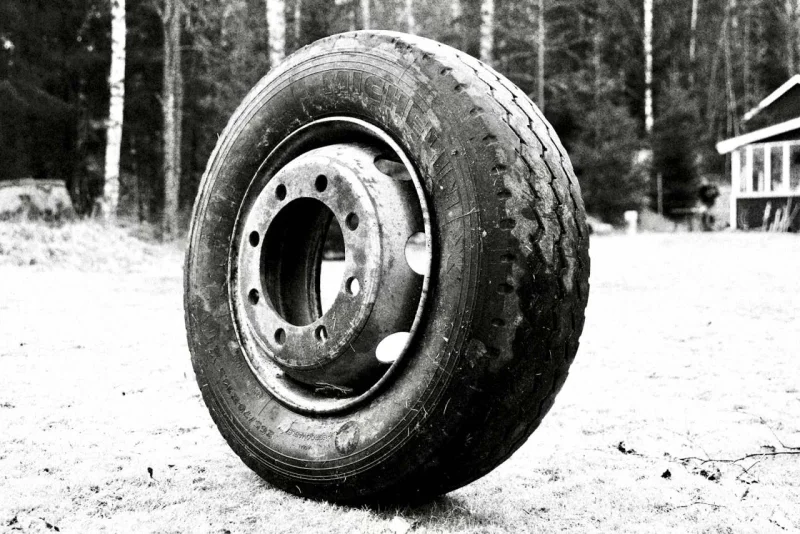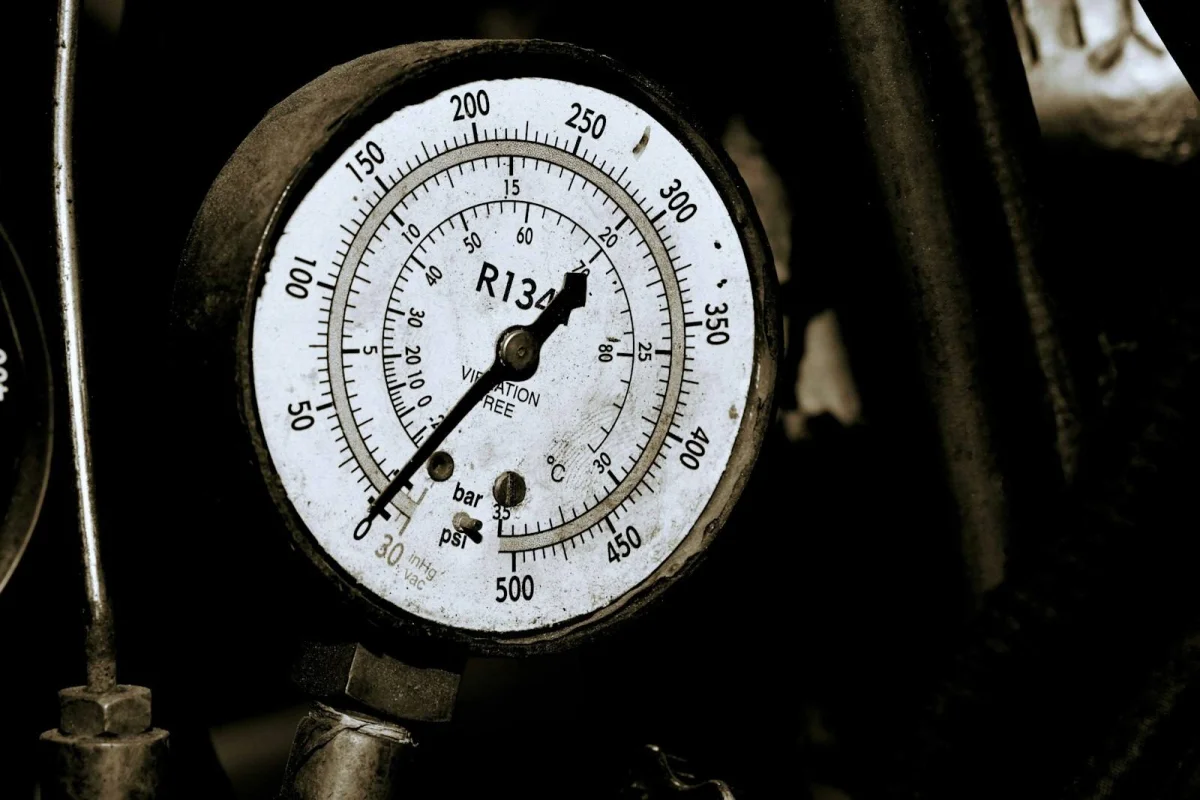
A tyre gauge reads "0" when the tyre is completely flat — not "minus 14.7 PSI," which is what it would read if it were truly measuring zero pressure — and this single design choice, "gauge pressure," is why almost every pressure reading you encounter in daily life is actually a difference, not an absolute amount
The previous articles on this site covered pressure unit conversion, tyre/blood/weather pressure readings, atmospheric pressure and altitude, and scuba diving physics. This article addresses gauge pressure vs absolute pressure — the distinction between "pressure relative to the surrounding atmosphere" and "pressure relative to a true vacuum" — which underlies every one of the previous articles' measurements, often without being stated explicitly.
Absolute pressure: measured from a true vacuum (zero molecules, zero pressure)
Absolute pressure is measured with zero as its reference point representing a perfect vacuum — no gas molecules, no pressure at all.
Standard atmospheric pressure at sea level is approximately 14.7 PSI (or 101.3 kPa, or 1 atm — covered in the original conversion article) in absolute terms — this represents the actual, total pressure exerted by the entire column of Earth's atmosphere above you, pressing down.
Gauge pressure: measured relative to the surrounding atmosphere
Most everyday pressure gauges — tyre gauges, blood pressure monitors, and many industrial pressure gauges — are calibrated to read zero when exposed to normal atmospheric pressure — not when exposed to a vacuum.
This means: "gauge pressure" = "absolute pressure" − "atmospheric pressure"
A tyre gauge reading "32 PSI" means the air inside the tyre is at 32 PSI above atmospheric pressure — in absolute terms, the air inside the tyre is at approximately 32 + 14.7 = 46.7 PSI absolute.
A "flat" tyre, reading "0 PSI" on a gauge — isn't a true vacuum (0 PSI absolute) — it means the air inside the tyre is at the same pressure as the surrounding atmosphere (≈14.7 PSI absolute) — the gauge reads "0" because there's no difference between inside and outside — which is, practically, what "flat" means — the tyre isn't holding any additional air beyond what the atmosphere itself provides.
Why "gauge pressure" is the practically useful measurement for most applications
For tyres, blood pressure, and most everyday/industrial pressure measurements — what matters is the difference between "inside" and "outside" — this difference is what determines whether a tyre holds its shape, whether blood flows through vessels, whether a pressurized vessel would rupture if a seal failed (the failure would be driven by the pressure difference across the seal, not by either side's absolute pressure alone).
Atmospheric pressure itself is "always there," pressing on everything, all the time — for most practical purposes, it's the "background" against which other pressures are meaningfully compared — gauge pressure automatically factors out this ever-present background, leaving the "interesting," application-relevant difference.
When absolute pressure is the relevant measurement
Some contexts require absolute pressure, specifically:
Weather/barometric pressure: as covered in the previous atmospheric-pressure article, weather forecasting uses absolute pressure (typically expressed in hPa/millibars, or inches/mm of mercury) — because what's meteorologically meaningful is the actual, total atmospheric pressure at a location — and how it compares to "standard" sea-level atmospheric pressure (≈1013 hPa) — not a "gauge"-style difference from some other reference.
Vacuum measurements: when measuring how close to a perfect vacuum something is (in scientific/industrial vacuum applications) — absolute pressure is necessary — "gauge pressure" relative to atmosphere would be negative for anything below atmospheric — and while negative gauge pressure (sometimes called "vacuum gauge" readings) is used in some contexts — for deep/precise vacuum work, absolute pressure figures are generally the more standard, unambiguous reference.
Certain gas-law calculations: scientific/engineering calculations involving the ideal gas law (PV = nRT, and related equations) require absolute pressure — using gauge pressure in such equations would produce incorrect results, since the equations relate to the actual, total pressure of the gas, not a difference from atmospheric.
Altitude and gauge pressure: a subtle interaction
The previous atmospheric-pressure article covered how atmospheric pressure decreases with altitude. For gauge-pressure measurements, this has a subtle consequence: a tyre inflated to "32 PSI" (gauge) at sea level, if transported, unchanged, to a higher altitude — its absolute pressure hasn't changed (assuming temperature constant and no air added/removed) — but the surrounding atmospheric pressure has decreased — the gauge reading would increase (the gauge reads the difference, and atmospheric pressure — one side of that difference — decreased, while the tyre's absolute pressure stayed the same — increasing the difference).
This effect is generally small for typical altitude changes encountered in everyday driving (a few hundred meters of elevation change corresponds to a relatively small atmospheric-pressure change, and correspondingly small gauge-reading effect) — but represents a genuine, if usually minor, additional factor alongside the temperature-based tyre-pressure changes that are generally the more significant, commonly-discussed factor for everyday tyre-pressure variation.
How to use the Pressure Converter on sadiqbd.com
- For most everyday conversions (tyre pressure, blood pressure): the values you're working with are almost certainly gauge pressure — units like PSI, bar, kPa, when displayed on typical gauges, represent gauge pressure by convention, even though "gauge" often isn't explicitly stated
- For weather/barometric pressure: values are absolute — converting between units (hPa, inches of mercury, etc.) for weather purposes doesn't involve the gauge/absolute distinction in the same way, since weather pressure is consistently absolute across these units
- If a calculation requires absolute pressure, but you only have a gauge reading: add local atmospheric pressure (≈14.7 PSI / ≈101.3 kPa / ≈1 atm at sea level, adjusted for altitude per the previous atmospheric-pressure article, if relevant) to the gauge reading to obtain the absolute value
Frequently Asked Questions
If gauge pressure is "relative to atmosphere," and atmospheric pressure changes with weather (not just altitude) — does a tyre gauge reading change with the weather, even at constant altitude? In principle, yes — though the effect is very small. Day-to-day atmospheric pressure variations due to weather (high/low pressure systems) are typically on the order of a few percent of total atmospheric pressure — translating to gauge-pressure effects of a fraction of a PSI, for typical tyre pressures (which are themselves, as a gauge value, roughly double atmospheric pressure — so a few-percent change in atmospheric pressure represents an even smaller percentage of the tyre's gauge reading). This effect is generally far smaller than, and swamped by, the temperature-driven tyre-pressure changes (covered in the previous atmospheric-pressure article) that occur from, e.g., driving (heating the tyre) or seasonal/daily temperature swings — weather-pressure-driven gauge effects are real, but practically negligible compared to temperature effects for everyday tyre-pressure purposes.
Is the Pressure Converter free? Yes — completely free, no sign-up required.
Try the Pressure Converter free at sadiqbd.com — convert between PSI, bar, kPa, atm, and mmHg instantly.