Why Your Ears Pop at Two Different Rates
Climb from sea level to 1,000 metres and your ears register the change. Descend two metres in a swimming pool and they register a comparable change.
A 500-fold difference in distance producing a similar sensation, because water is roughly 800 times denser than air at sea level.
That density ratio explains most of what's counterintuitive about pressure: why aircraft cabins are pressurised, why deep diving is dangerous, and why a weather system moving through barely registers while a short dive does.
Where Pressure Comes From
Pressure is force per unit area:
P = F / A
For a fluid column, the force is the weight of everything above you:
P = ρ × g × h
Density times gravitational acceleration times height.
In water: ρ ≈ 1,000 kg/m³, so every 10 metres of depth adds roughly 1 atmosphere — about 101 kPa, or 14.7 psi.
In air: ρ ≈ 1.2 kg/m³ at sea level, so you'd need roughly 8 kilometres of air to add the same pressure. And air is compressible, so its density falls with altitude, which makes the relationship exponential rather than linear.
That's the whole asymmetry. Water is dense and incompressible; air is thin and compressible.
The Pressure Converter translates between the units each field uses:
- Enter the value.
- Select the source unit — psi, bar, kPa, atm, mmHg.
- Read the equivalents.
Reference points worth knowing:
1 atm = 101.325 kPa = 1.01325 bar = 14.696 psi = 760 mmHg
Gauge vs Absolute: The Distinction That Matters Most
Almost every pressure reading you encounter is a difference, not an absolute value.
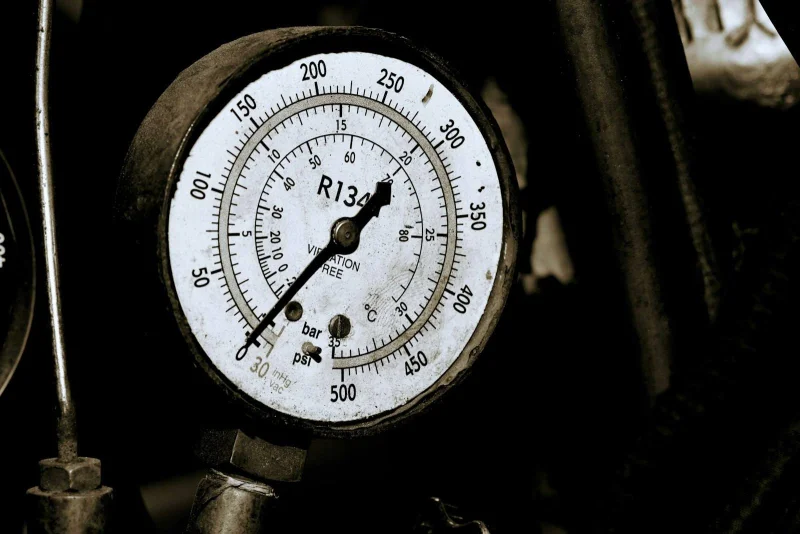
Gauge pressure is measured relative to ambient atmospheric pressure. A tyre gauge reading 32 psi means 32 psi above the surrounding air.
Absolute pressure is measured from a perfect vacuum.
absolute = gauge + atmospheric
A tyre at 32 psi gauge is at about 46.7 psi absolute at sea level.
Units sometimes carry a suffix — psig for gauge, psia for absolute — but frequently don't, and the omission causes real errors.
Where it matters:
Tyre pressures are gauge. A flat tyre reads 0 psi gauge, not 0 absolute. This is also why tyre pressure appears to drop at altitude — the ambient pressure fell, but the gauge reads a difference, so the reading changes even though the air inside hasn't.
Blood pressure is gauge, relative to atmospheric. A reading of 120/80 mmHg means 120 mmHg above ambient.
Weather pressure is absolute. A barometric reading of 1013 hPa is the actual atmospheric pressure.
Scuba and industrial gas pressures are often specified in absolute, because gas law calculations require absolute values. Using gauge pressure in a gas law calculation produces wrong answers.
Vacuum readings may be expressed as absolute pressure, or as negative gauge pressure, or as inches of mercury below atmospheric. Three conventions for the same physical state.
Water: Linear and Fast
Underwater, pressure increases linearly with depth because water is essentially incompressible.
10 m  → 2 atm absolute
20 m  → 3 atm absolute
30 m  → 4 atm absolute
40 m  → 5 atm absolute
The first 10 metres doubles the absolute pressure. No subsequent 10 metres does anything as dramatic — 30 to 40 metres is only a 25% increase.
This is why the shallowest part of a dive involves the largest relative pressure changes, and why ascent rules are strictest near the surface.
Boyle's law governs what this does to gas volumes:
P₁V₁ = P₂V₂
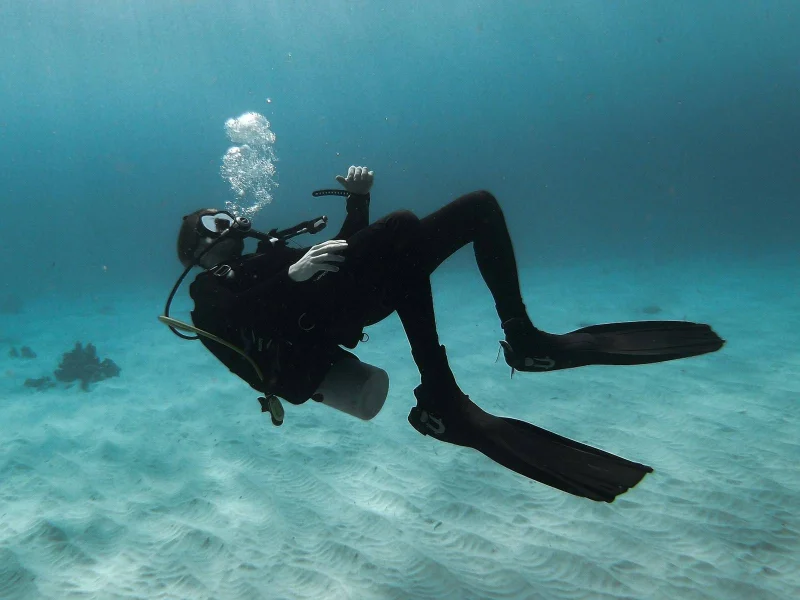
A lungful of air at 20 m (3 atm) expands to three times its volume at the surface. This is the physics behind the fundamental scuba rule of never holding your breath on ascent — expanding gas with nowhere to go causes lung overexpansion injury, which can occur in very shallow water.
Nitrogen absorption scales with partial pressure. At depth, more nitrogen dissolves into tissue; on ascent, it must come out of solution gradually. Ascend too fast and it forms bubbles — decompression sickness. Dive tables and computers exist to manage this, and diving is something to learn properly with training rather than from physics alone.
Air: Exponential and Slow
Atmospheric pressure falls exponentially with altitude, because the air itself compresses under its own weight.
Approximate values:
Sea level:     101 kPa   (100%)
1,000 m:        90 kPa   (89%)
2,500 m:        75 kPa   (74%)
5,500 m:        50 kPa   (50%)
8,850 m:        34 kPa   (33%)  — Everest summit
Roughly, pressure halves every 5,500 metres.
The physiological issue isn't the pressure itself so much as the reduced partial pressure of oxygen. Air is about 21% oxygen at every altitude — the proportion doesn't change. What changes is total pressure, so the partial pressure of oxygen falls proportionally, and less oxygen crosses into the blood per breath.
At 5,500 m, oxygen partial pressure is about half its sea-level value. This is why acclimatisation takes time and why supplemental oxygen is used at extreme altitude.
Aircraft cabins are pressurised to an equivalent altitude of roughly 1,800–2,400 m rather than to sea level. Full sea-level pressurisation would require a much stronger and heavier fuselage to withstand the pressure differential at cruising altitude. The compromise is a cabin where most people are comfortable and the structural load is manageable.
Why Different Fields Use Different Units
mmHg for blood pressure. Originally literal — early sphygmomanometers used a mercury column, and the height of that column in millimetres was the reading. The instruments changed; the unit stayed, because a century of clinical reference ranges are expressed in it.
psi and bar for tyres. Regional convention. North America uses psi; much of Europe uses bar. 1 bar ≈ 14.5 psi, and bar was chosen partly because it's conveniently close to 1 atmosphere.
hPa or mbar for weather. Meteorology standardised on the hectopascal, which is numerically identical to the millibar — 1 hPa = 1 mbar. Standard sea-level pressure is 1013.25 hPa.
Pascals and MPa in engineering. The SI unit. A pascal is very small — one newton per square metre — so practical engineering uses kPa and MPa.
inHg in aviation and some US contexts. Altimeter settings in North America use inches of mercury; most of the world uses hPa.
The proliferation isn't irrationality. Each field standardised on whatever its instruments produced, and the cost of changing a unit that underpins decades of reference data usually exceeds the benefit.
Temperature Changes Pressure
For a fixed volume of gas, pressure scales with absolute temperature:
P₁/T₁ = P₂/T₂ (temperatures in kelvin)
Tyres. A rough rule is that pressure changes by about 1 psi for every 5.5°C change. Check tyres cold — driving heats them and raises the reading. A tyre correctly inflated in a warm garage will read low outside on a cold morning, and it isn't leaking.
Gas cylinders. A cylinder filled in summer and used in winter reads lower. The gas quantity is unchanged.
Seasonal drift. This is why tyre pressure warnings cluster in autumn as temperatures drop.
Practical Tips
Always establish gauge or absolute before using a pressure figure in any calculation.
Use absolute pressure in gas law calculations. Gauge values give wrong answers.
Check tyres cold, and adjust for significant ambient temperature changes.
Remember the doubling depths. The first 10 m underwater is the biggest relative change of any 10 m segment.
Distinguish partial pressure from total pressure when reasoning about altitude physiology. Oxygen percentage doesn't change; partial pressure does.
Watch for hPa/mbar equivalence. They're the same number, which occasionally confuses people expecting a conversion.
FAQ
What's the difference between gauge and absolute pressure? Gauge is measured relative to ambient atmospheric pressure; absolute is measured from vacuum. Absolute = gauge + atmospheric.
Why does pressure increase faster in water than in air? Water is roughly 800 times denser at sea level, and it's incompressible. Ten metres of water adds about one atmosphere; air needs kilometres.
Why is blood pressure measured in mmHg? Early instruments used a mercury column and the reading was literally its height. Clinical reference ranges have been expressed in that unit ever since.
Why do aircraft cabins feel like altitude? They're pressurised to roughly 1,800–2,400 m equivalent rather than sea level, because full pressurisation would require a much heavier fuselage.
Does oxygen percentage drop at altitude? No. Air remains about 21% oxygen. Total pressure falls, so the partial pressure of oxygen falls with it.
Why do my tyres read low in winter? Gas pressure falls with temperature. Roughly 1 psi per 5.5°C. The tyre isn't necessarily leaking.
The Takeaway
Pressure behaves completely differently in water and air for one reason: density. Ten metres of water does what eight kilometres of air does. Once that ratio is clear, the diving rules, the altitude physiology and the cabin pressurisation compromise all follow from the same equation — and the gauge-versus-absolute distinction is what keeps the arithmetic honest.
Convert between psi, bar, kPa, atm and mmHg free with the Pressure Converter at sadiqbd.com — no sign-up, instant results.