Frequency spans more than 20 orders of magnitude — and you work with it daily
The electricity coming out of your wall socket oscillates at 50 Hz. Your phone connects to WiFi at 2.4 GHz. Your computer processor ticks at 3.6 GHz. A medical ultrasound probe operates at 1–20 MHz. Radio stations broadcast at 88–108 MHz. Your heart beats at roughly 1 Hz (60 BPM = 1 beat per second).
From heartbeats to gamma rays, frequency is one of the most fundamental measurements in science and engineering. The challenge is that practical applications use units spanning from millihertz to terahertz — and translating between them quickly requires a reliable converter.
The Frequency Scale from Slow to Fast
Sub-hertz frequencies (< 1 Hz)
Millihertz (mHz) range: geological cycles, ultra-low-frequency communications, very slow oscillations in process control systems.
A human heartbeat at rest (60 BPM) = 1 Hz. A very slow resting heart rate (40 BPM) = 0.67 Hz.
Audio range (20 Hz – 20 kHz)
The range of human hearing. A and D tuning fork vibrate at 440 Hz and 293.7 Hz respectively. Bass guitar strings: 41–300 Hz. The highest note on a piano: ~4,186 Hz.
20 Hz = the lowest bass humans can hear 20,000 Hz = 20 kHz = the highest frequency young adults can hear (this limit drops with age and noise exposure)
Ultrasound (20 kHz – several MHz)
Above human hearing. Bats navigate at 20–100 kHz. Medical ultrasound imaging: 1–20 MHz. Industrial ultrasonic cleaning: 20–400 kHz.
Radio and microwave (MHz – GHz)
AM radio: 540–1,700 kHz FM radio: 88–108 MHz WiFi 2.4 GHz band: 2,400–2,484 MHz WiFi 5 GHz band: 5,180–5,825 MHz Mobile 4G LTE: 700 MHz – 3.5 GHz Mobile 5G: 600 MHz – 100 GHz (mmWave) Microwave ovens: 2.45 GHz
Processor clocks (GHz)
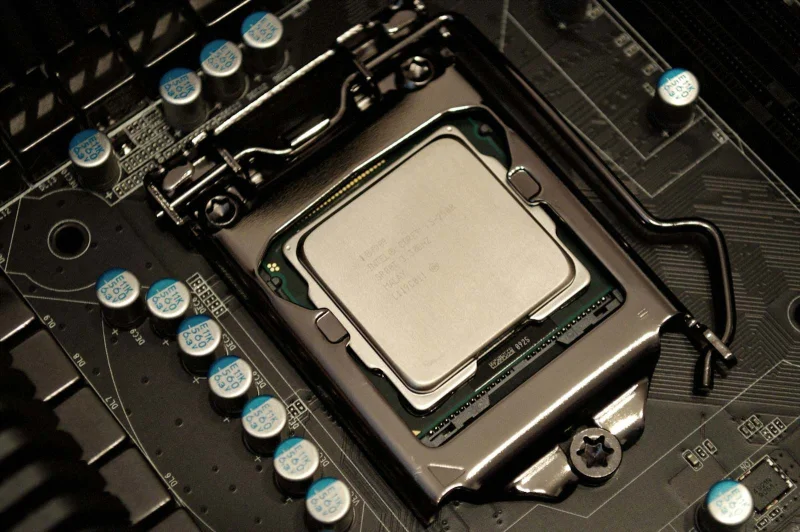
Modern CPUs operate at 2–5+ GHz. Each GHz = 1 billion clock cycles per second. At 3.6 GHz: 3,600,000,000 cycles per second.
Light and beyond (THz and above)
Infrared radiation: 300 GHz – 400 THz Visible light: 430–770 THz (red to violet) X-rays and gamma rays: 3 × 10^16 Hz and above
How to Use the Frequency Converter on sadiqbd.com
- Enter the frequency value
- Select the source unit — Hz, kHz, MHz, GHz, THz, or RPM
- Read the converted values — all equivalent units displayed
Real-World Conversion Examples
Motor RPM to Hz and back
A 4-pole synchronous motor on Bangladesh's 50 Hz grid:
Synchronous speed = (2 × frequency × 60) ÷ number of poles = (2 × 50 × 60) ÷ 4 = 1,500 RPM
Converting 1,500 RPM to Hz: 1,500 ÷ 60 = 25 Hz
This is why most 4-pole motors in Bangladesh show "1,500 RPM" on their nameplates — it's the synchronous speed on a 50 Hz grid.
Audio equaliser frequency bands
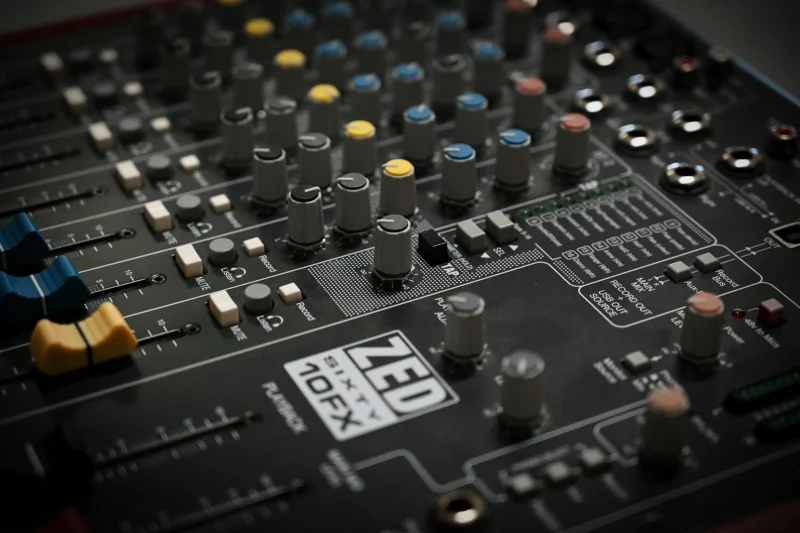
An audio mixer has EQ bands at:
- Low shelf: 80 Hz — affects bass
- Low-mid: 250 Hz
- Mid: 1 kHz = 1,000 Hz
- Upper-mid: 4 kHz = 4,000 Hz
- High shelf: 12 kHz = 12,000 Hz
Understanding these as Hz helps a sound engineer relate them to instrument frequency ranges: a bass guitar's fundamental notes are 41–300 Hz; vocals are 80 Hz – 3 kHz; cymbals are 8–16 kHz.
WiFi channel frequencies
A WiFi router broadcasts on channel 6 of the 2.4 GHz band. The centre frequency of channel 6 is 2.437 GHz = 2,437 MHz.
Your laptop's network card connects at 2.437 GHz. Converting for context: 2,437 MHz = 2,437,000 kHz = 2,437,000,000 Hz. Nearly 2.5 billion oscillations per second to carry your internet traffic.
Comparing 50 Hz vs. 60 Hz power grids
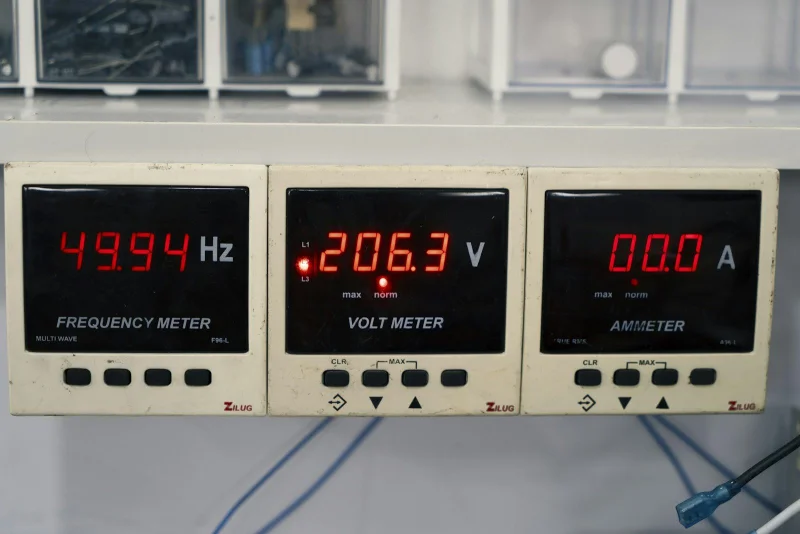
Bangladesh uses 50 Hz (like most of Asia, Europe, and Africa). The US uses 60 Hz (North America, parts of South America, Japan).
A 50 Hz synchronous motor designed for Bangladesh would run 20% faster in the US (60/50 = 1.2×): Standard Bangladesh motor speed: 1,500 RPM → would run at 1,800 RPM on a US grid. This causes overheating, accelerated wear, and in some motors, mechanical failure.
This is why electrical equipment specifies its designed frequency and why transformers and frequency converters are needed when using equipment across grid types.
Frequency and Wavelength
Electromagnetic frequency and wavelength are inversely related via the speed of light (c ≈ 3 × 10^8 m/s):
Wavelength (λ) = c ÷ frequency
At 100 MHz (FM radio): λ = 3 × 10^8 ÷ 10^8 = 3 metres At 2.4 GHz (WiFi): λ = 3 × 10^8 ÷ 2.4 × 10^9 = 0.125 metres = 12.5 cm At 5 GHz (WiFi): λ = 3 × 10^8 ÷ 5 × 10^9 = 0.06 metres = 6 cm
This is why 5 GHz WiFi has shorter range than 2.4 GHz — higher frequency = shorter wavelength = less penetration through walls and obstacles.
Frequency in Audio Production
For musicians, sound engineers, and podcasters, frequency is the backbone of sound design:
Fundamental frequency: The pitch of a note. Middle C = 261.63 Hz. Concert A = 440 Hz.
Harmonics: Whole-number multiples of the fundamental. The warmth and timbre of instruments come from their harmonic content above the fundamental.
Equal temperament: The notes of a standard 12-tone octave each differ by a factor of 2^(1/12) ≈ 1.0595. Going up one octave doubles the frequency: A4 = 440 Hz, A5 = 880 Hz, A3 = 220 Hz.
The frequency converter helps when moving between musical references (Hz, note names), audio engineering (kHz), and acoustic physics.
Tips for Working With Frequencies
Distinguish Hz from RPM clearly. RPM is revolutions per minute; Hz is cycles per second. To convert: RPM ÷ 60 = Hz. A motor at 3,000 RPM runs at 50 Hz. Confusing the two can produce dangerous motor speed calculations.
Be aware of your clock's unit. Computer clock speeds in GHz are orders of magnitude larger than audio frequencies in Hz. A 3.2 GHz processor and a 3.2 kHz audio frequency differ by a factor of one million.
Check your grid frequency before using foreign electrical equipment. 50 Hz vs. 60 Hz matters for motors, timing circuits, and some power supplies.
Frequently Asked Questions
How many Hz is 1 GHz? 1 GHz = 1,000,000,000 Hz = 10^9 Hz. One billion cycles per second.
What's the frequency of visible light? Visible light spans approximately 430 THz (red end) to 770 THz (violet end). In wavelength: 700nm (red) to 400nm (violet). These are electromagnetic frequencies far above any radio or microwave frequency.
Why does higher frequency WiFi have shorter range? Higher frequency signals have shorter wavelengths that are more easily absorbed by walls and objects. 5 GHz WiFi carries more data (higher bandwidth) than 2.4 GHz but doesn't penetrate obstacles as well.
Is the frequency converter free? Yes — completely free, no sign-up required.
Frequency connects music, radio, computing, power engineering, and physics into one continuous spectrum. The converter removes the unit barriers so comparisons across these domains become instant.
Try the Frequency Converter free at sadiqbd.com — convert between Hz, kHz, MHz, GHz, THz, and RPM instantly.