The Notation That Makes Bread Recipes Comparable
Open two sourdough recipes. One calls for 500 g flour, 375 g water, 10 g salt and 100 g starter. The other calls for 800 g flour, 520 g water, 16 g salt and 160 g starter.
Are they the same bread? At a glance, no idea. The numbers share nothing obvious.
Convert both to baker's percentage and the answer appears instantly:
Recipe 1: 100% flour, 75% water, 2% salt, 20% starter Recipe 2: 100% flour, 65% water, 2% salt, 20% starter
Same salt, same starter, ten percentage points apart on hydration. Recipe 1 will be wetter, more open-crumbed, and harder to handle. Recipe 2 will be tighter and more forgiving.
That's the entire value of the notation: it makes recipes comparable, scalable, and diagnosable.
How Baker's Percentage Works
Every ingredient is expressed as a percentage of the total flour weight, which is always 100%.
ingredient % = (ingredient weight / total flour weight) × 100
The percentages sum to more than 100%, which surprises people the first time. That's correct — they're ratios to flour, not proportions of the whole.
A basic lean dough:
| Ingredient | Weight | Baker's % |
|---|---|---|
| Bread flour | 1000 g | 100% |
| Water | 680 g | 68% |
| Salt | 20 g | 2% |
| Instant yeast | 7 g | 0.7% |
Total flour is always the denominator, even with multiple flours. If you use 800 g bread flour and 200 g wholemeal, total flour is 1000 g, and the two flours are 80% and 20% respectively.
Preferments complicate this slightly. The flour and water inside a starter or poolish count toward the totals. A recipe using 200 g of 100% hydration starter is contributing 100 g flour and 100 g water to the overall figures. Recipes that ignore this report hydration figures that are misleadingly low.
What the Numbers Tell You
Once you're reading in percentages, you can predict how a dough will behave before you mix it.
Hydration — the big one
- 55–60%: stiff. Bagels, some pasta doughs, pretzels. Difficult to knead by hand, holds shape well.
- 60–65%: standard sandwich loaves and enriched breads. Easy to handle, tight even crumb.
- 65–70%: most everyday artisan bread. Manageable, decent open crumb.
- 70–80%: ciabatta, high-hydration sourdough. Sticky, needs folding rather than kneading, produces the large irregular holes people chase.
- 80%+: very slack. Requires technique and usually a banneton or tin.
The single most useful diagnostic in bread baking: if your dough is behaving unexpectedly, calculate the hydration and compare it to the range for the style you're making.
Salt
Almost always 1.8–2.2%. Below about 1.5% the bread tastes flat and fermentation runs faster than expected — salt slows yeast activity. Above about 2.5% it tastes salty and fermentation drags.
This tight range makes salt a good sanity check. If a recipe's salt works out to 0.8% or 4%, either it's a typo or you've misread a unit.
Yeast
Highly variable because it trades off against time and temperature. Roughly:
- Instant yeast: 0.5–1% for a same-day dough, 0.1–0.3% for a long cold ferment
- Fresh yeast: roughly three times the instant weight
- Sourdough starter: 10–30% depending on schedule and ambient temperature
Halving the yeast and doubling the time generally produces better flavour, which is the principle behind overnight and cold-retard methods.
Fat and sugar
Above about 5% fat and 5% sugar you're into enriched territory — brioche, challah, sweet buns. Both interfere with gluten development, so enriched doughs need different handling and usually more yeast, since sugar at high concentrations slows fermentation through osmotic pressure.
Scaling a Recipe to What You Have
This is where percentages become genuinely practical.
Scenario: you have 650 g of flour left and want to use all of it.
Take your standard formula — 100% flour, 70% water, 2% salt, 0.6% yeast — and multiply each percentage by 650:
Flour:  650 g
Water:  650 × 0.70 = 455 g
Salt:   650 × 0.02 = 13 g
Yeast:  650 × 0.006 = 3.9 g
Done. No proportional arithmetic across four separate ingredients, no rounding errors accumulating.
Scenario: you want to make exactly 900 g of finished dough.
Sum the percentages first: 100 + 70 + 2 + 0.6 = 172.6%. Then:
Flour needed = 900 / 1.726 = 521 g
Apply the percentages to that. You'll lose a small amount to evaporation during baking, so add a few percent if the target is finished loaf weight rather than dough weight.
Scenario: you want to convert a cup-based recipe.
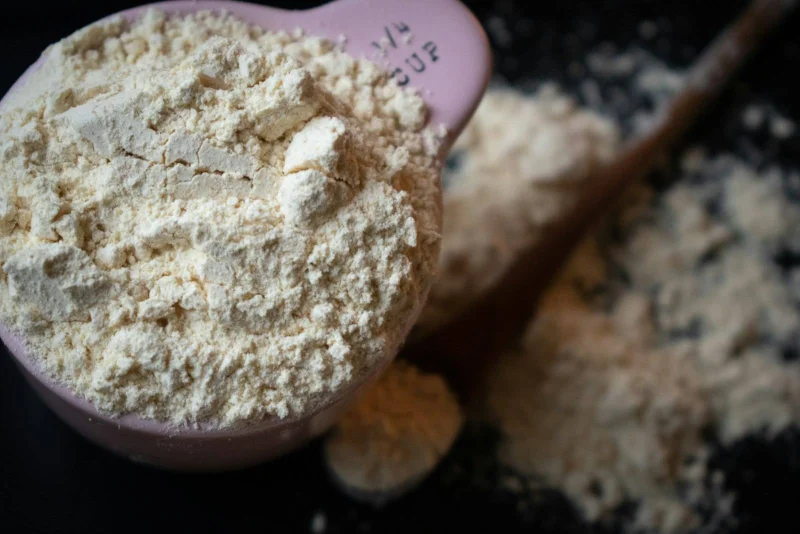
This is where the conversion has to happen first. Volume measures of flour vary substantially depending on how the cup is filled — scooping compacts flour and can add a significant amount over spooning it in. That variation makes percentage calculations meaningless until you've converted to weight.
Use the Cooking Converter to translate the volume measures:
- Enter the volume amount from the recipe.
- Select the source unit (cups, tablespoons, fluid ounces).
- Select grams or millilitres as the target.
- Note the weight for each ingredient.
- Divide each by the flour weight to get the baker's percentage.
Once you have the formula in percentages, you never need to convert that recipe again.
Adapting a Formula Deliberately
Percentages turn recipe modification from guesswork into something you can reason about.
Adding wholemeal flour. Wholemeal absorbs more water than white. A common adjustment is raising hydration by roughly 1–2% for every 10% of wholemeal substituted. Swapping 20% of your white flour for wholemeal in a 70% hydration dough might mean moving to 72–74%.
Moving to a longer ferment. Reduce yeast rather than changing anything else. Going from a 3-hour bulk to an overnight cold retard typically means cutting yeast to a fraction of the original.
Working in a hot kitchen. Fermentation speeds up considerably with temperature. Reduce yeast, use cooler water, or shorten the bulk. The percentages give you a stable baseline to adjust from.
Building a formula from scratch. Start at 100% flour, 68% water, 2% salt, 0.6% instant yeast. That's a solid everyday loaf. Move one variable at a time and record what happens.
Common Mistakes
Forgetting preferment flour and water. A recipe with a large poolish that reports "70% hydration" excluding the preferment is really running considerably wetter. Always calculate overall hydration including everything.
Comparing hydration across flour types. A 75% hydration dough with a strong high-protein bread flour handles very differently from 75% with a weaker plain flour. The percentage is comparable; the resulting dough isn't, unless the flour is similar.
Measuring salt by volume. Fine table salt and flaky sea salt differ hugely in weight per spoon — a teaspoon of one can be nearly double the other. Salt is one of the ingredients where the tight percentage range makes volume error most costly. Weigh it.
Rounding yeast carelessly. At 0.4% of 500 g you need 2 g. Rounding to 3 g is a 50% increase in leavening. Use a scale that reads to 0.1 g for small quantities, or scale up your batch.
Treating percentages as proportions of the total. They're ratios to flour. Summing to 175% is normal and correct.
FAQ
Why is flour always 100%? It's the reference ingredient, since flour structure determines almost everything about how a dough behaves. Fixing it at 100% makes every other ingredient directly comparable across recipes.
Does baker's percentage work for cakes and pastry? Yes, and it's used in professional pastry for the same reasons. The typical ranges differ enormously — cake batters have far higher sugar, fat and liquid percentages than bread.
How do I calculate hydration with a sourdough starter? Split the starter into its flour and water components based on its own hydration, add each to the respective totals, then compute. A 100% hydration starter is half flour, half water by weight.
Can I use baker's percentage with volume measurements? Not reliably. Volume measures of flour vary too much to give consistent ratios. Convert to weight first.
What hydration should I start with? Around 65–68% for a first artisan loaf. It's forgiving enough to handle and open enough to be interesting. Move up gradually as your handling improves.
The Takeaway
Baker's percentage is just division, but it converts a recipe from a fixed set of quantities into a formula you can scale, compare and adjust with intent. Once your regular recipes are written this way, "I only have 700 grams of flour" stops being a problem and becomes a one-line calculation.
Convert between cups, tablespoons, millilitres and grams free with the Cooking Converter at sadiqbd.com — no sign-up, instant results.