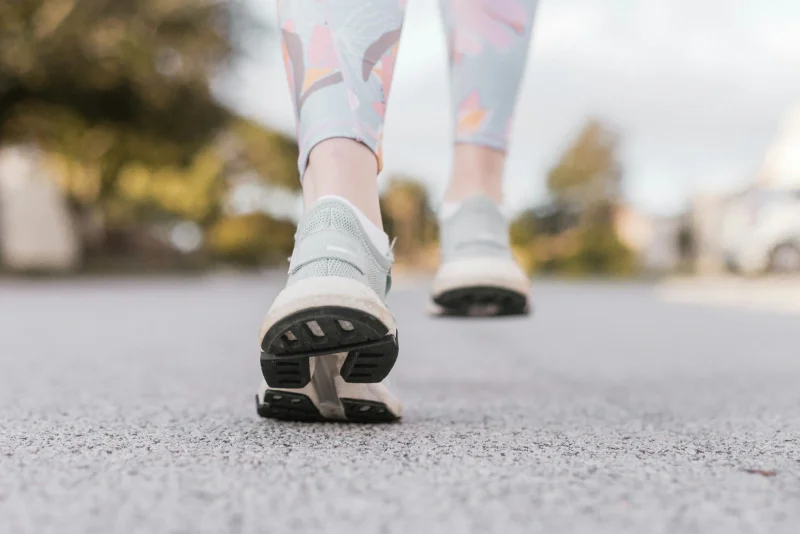
Walking is the most accessible form of exercise — and more effective than most people credit
You don't need a gym membership, specialised equipment, or a dedicated workout time slot. Walking works. Research consistently shows that regular walking reduces cardiovascular risk, improves metabolic health, supports weight management, and benefits mental health. The 10,000 steps/day figure has become culturally embedded as a target — but where does it come from, and how many calories does hitting it actually burn?
A steps-to-calories calculator answers the second question accurately, based on your weight and step count.
How Step-to-Calorie Conversion Works
The calculation uses two inputs:
- Step count — total steps taken
- Body weight — heavier people burn more calories for the same movement
The underlying formula uses MET (Metabolic Equivalent of Task) values for walking at different speeds. For average walking pace:
Approximate formula: Calories = (steps × 0.04) × (weight in kg / 70)
For a 70 kg person walking 10,000 steps: = (10,000 × 0.04) × (70/70) = 400 × 1 = ~400 calories
For an 85 kg person: = (10,000 × 0.04) × (85/70) = 400 × 1.214 = ~486 calories
Some calculators refine this using stride length (affecting the actual distance covered per step) and walking speed. The calculator on sadiqbd.com takes weight and step count as minimum inputs for a reliable estimate.
Steps to Distance Conversion
Step count doesn't directly tell you distance without knowing stride length, which varies by height and walking pace.
Average stride length estimates:
- Men: approximately 78 cm per step (1.56 m per two steps)
- Women: approximately 67 cm per step (1.34 m per two steps)
At these averages:
- 10,000 steps ≈ 7–8 km for most adults
For comparison:
- 5,000 steps ≈ 3.5–4 km
- 15,000 steps ≈ 10.5–12 km
Real-World Examples
Daily commuter walking estimate
Kamal walks to and from the bus stop and around his office during the day. His fitness tracker records 6,500 steps. He weighs 75 kg.
Calories burned = (6,500 × 0.04) × (75/70) = 260 × 1.071 = ~279 calories
That's a meaningful burn from activity he's already doing — no additional exercise time required. Over 5 workdays: ~1,395 calories, roughly equivalent to 0.2 kg of fat per week.
Hitting a 10,000-step target
A 62 kg woman sets a daily 10,000-step goal as part of a weight management plan.
Calories burned daily = (10,000 × 0.04) × (62/70) = 400 × 0.886 = ~354 calories
Monthly burn from steps alone: ~10,620 calories ≈ approximately 1.2 kg of fat equivalent per month, combined with a moderate dietary adjustment.
Comparing step counts across days
Weekend day: 14,000 steps (85 kg person) = (14,000 × 0.04) × (85/70) = 560 × 1.214 = ~680 calories
Weekday: 4,000 steps = (4,000 × 0.04) × 1.214 = ~194 calories
The 10,000-step difference between days accounts for ~486 calories — a substantial variance that explains why weekday/weekend eating behaviours need to align with activity differences.
The 10,000 Steps Origin Story
The 10,000 steps/day figure is widely cited as a health target, but its origin is marketing rather than science. It comes from a Japanese pedometer brand called "Manpo-kei" (万歩計 — "10,000 steps meter") launched in 1965 ahead of the Tokyo Olympics, timed to capitalise on fitness enthusiasm.
What does the research actually say?
A 2019 Harvard study found that women who averaged 4,400 steps/day had significantly lower mortality rates than those averaging 2,700 steps — with benefits continuing up to about 7,500 steps, after which mortality rates plateaued. More steps were not harmful, but the marginal benefit above 7,500–8,000 was small.
More recent studies show similar patterns for various populations. The takeaway: 7,000–8,000 steps/day captures most of the health benefit. 10,000 is a memorable round number that's fine as a target, but not magic.
Steps vs. Other Exercise for Calorie Burn
Walking is efficient for calorie burn relative to effort — but lower intensity means lower burn per minute than running, cycling, or HIIT.
For a 70 kg person:
| Activity | Calories / 30 min |
|---|---|
| Walking (5 km/h) | ~130 |
| Jogging (8 km/h) | ~245 |
| Cycling (moderate) | ~200 |
| 10,000 steps (~90 min) | ~400 |
Walking's advantage is sustainability and zero barrier to entry — it can be done anywhere, anytime, without recovery time. The cumulative calorie burn from daily walking often exceeds what people achieve with sporadic, more intense exercise they struggle to maintain.
Tips for Increasing Your Daily Step Count
Walk during calls. Phone calls that don't require a screen are an easy opportunity for walking. A 15-minute call pacing around a room adds 1,500–2,000 steps.
Take stairs. Stairs don't add much to step count, but they burn significantly more calories per floor than flat walking and build lower-body strength.
Walk during lunch. A 15-minute post-lunch walk adds 1,500–2,000 steps and also supports blood sugar regulation after eating.
Get off a stop early. One stop early on a bus route can add 1,000–2,000 steps depending on the route.
Set a step goal you'll actually hit. Starting at 8,000 and consistently hitting it beats setting 12,000 and averaging 5,000. Realistic targets build the habit.
Frequently Asked Questions
How many steps equal 1 km? Approximately 1,250–1,500 steps per km for most adults, depending on stride length. A taller person with a longer stride covers more distance per step. At average stride length: 10,000 steps ≈ 7–8 km.
Do steps on an incline burn more calories? Yes — significantly. Walking uphill increases MET substantially. A 10% incline roughly doubles the calorie burn compared to flat walking at the same speed. Most step counters don't account for this; actual burn on hilly routes is higher than the calculator estimates.
Are steps from running counted the same as walking? The step-to-calorie conversion differs by speed. Running steps cover more distance and burn more calories per step. If your tracker counts all steps the same, the calorie estimate for mixed walking/running days will be approximate.
Does carrying weight (backpack, grocery bags) increase calorie burn? Yes — carrying extra load increases calorie burn, roughly proportionally to the added weight as a percentage of body weight. A 70 kg person carrying a 7 kg bag burns approximately 10% more calories per step.
Is the steps-to-calories calculator free? Yes — completely free, no sign-up required.
Walking is underrated as a health intervention. It's free, low-impact, sustainable, and cumulatively effective for calorie balance and cardiovascular health. The calculator puts a real number on what your daily steps are actually doing for you.
Try the Steps to Calories Calculator free at sadiqbd.com — find out how many calories your daily steps are burning based on your weight.