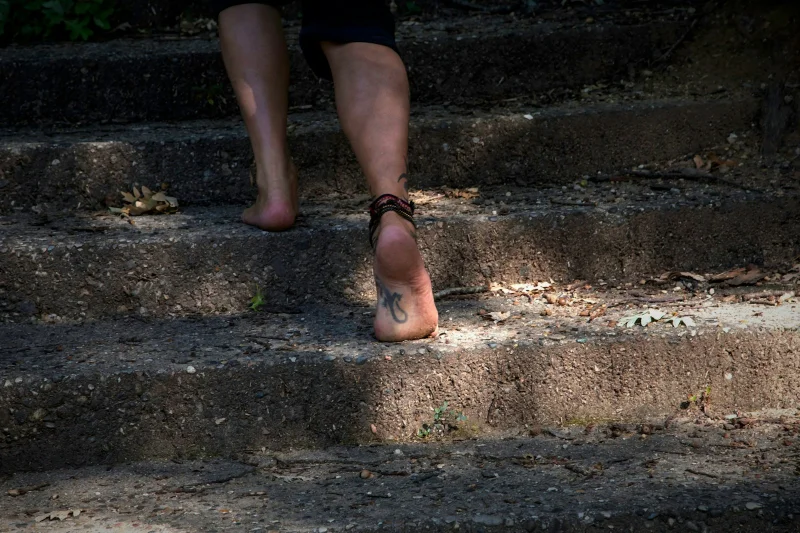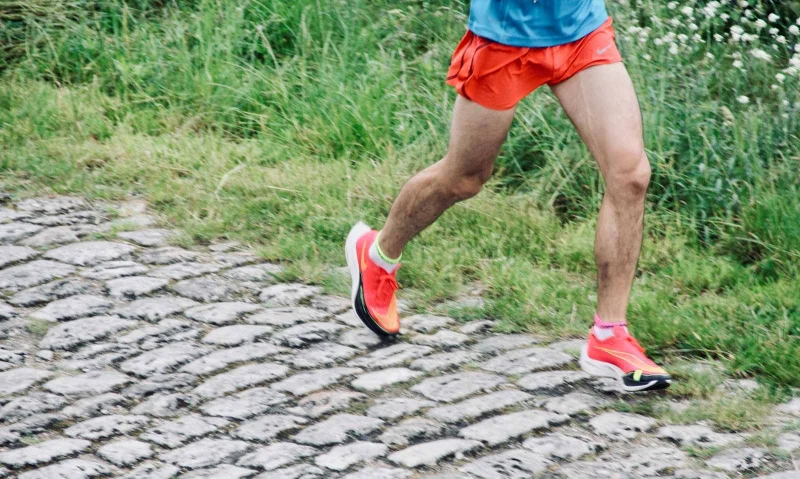
Walking uphill burns more calories than walking on flat ground for the same number of steps — but most step-to-calorie calculators don't account for this, which is why two people doing "10,000 steps" in very different terrain get very different actual calorie expenditure
The previous articles on this site covered step-to-calorie basics, the 10,000 steps research, walking pace and longevity, and how step counters work. This article addresses terrain and gradient — the factor that most step-based calorie calculators ignore and that causes the largest real-world discrepancy between calculated and actual energy expenditure.
Why gradient matters: the physics of walking uphill
On flat ground, walking requires energy primarily to:
- Move the body's center of mass forward (overcoming inertia and air resistance)
- Control the "falling forward" motion of normal gait
- Maintain balance and posture
Walking uphill adds a third major energy cost:
- Lifting the body's weight against gravity — the work done equals
mass × gravity × vertical height gained
The energy to climb 1 meter vertically is approximately 9.8 J/kg (potential energy from the formula PE = mgh, where g = 9.8 m/s²). For a 70 kg person climbing 100 meters of vertical gain:
- Energy = 70 × 9.8 × 100 = 68,600 J ≈ 16.4 kcal from the climbing component alone
- Plus the flat-walking component (to cover whatever horizontal distance corresponds to that ascent)
A step counter tracking steps on a 10% grade hill counts the same number of steps per unit of horizontal distance as on flat ground — but the calorie expenditure is substantially higher due to the vertical work. Steps don't capture vertical distance.
The MET system and terrain adjustment
Physical activity intensity is commonly expressed in "METs" (Metabolic Equivalents) — a multiple of the resting metabolic rate (1 MET = energy burned at rest). Walking speeds at various gradients have established MET values from exercise physiology research:
On flat ground:
- Slow walk (3 km/h): ~2.5 METs
- Moderate walk (4.5 km/h): ~3.5 METs
- Brisk walk (6 km/h): ~4.5 METs
On gradient:
- Walking uphill at 5% grade: adds roughly 1-2 METs to the flat-equivalent value
- Walking uphill at 10% grade: adds roughly 3-4 METs
- Hiking on rough terrain: typically 5-8 METs depending on grade and terrain
The calorie calculation using METs:
Calories/hour = MET × body weight (kg) × 0.0175 × 60
Or equivalently: Calories = MET × body weight (kg) × duration (hours)
A 70 kg person walking brisk (4.5 METs) for 1 hour burns: 4.5 × 70 × 1 = 315 kcal
The same person walking uphill at 10% grade (7.5 METs) for 1 hour burns: 7.5 × 70 × 1 = 525 kcal — 67% more, for the same time and approximately the same step count.
Why GPS-enabled devices do better (but still estimate)
Smartphone-based step counters using GPS can track elevation changes — allowing devices to account for gradient in calorie calculations. This is why a fitness app's GPS-tracked outdoor walk may show different calorie estimates than its step-counter-only mode for the same walk.
Even GPS-based estimates have limitations:
- GPS elevation accuracy is typically ±10-30 meters — sufficient for general tracking but not precise enough to credit a 20-meter climb accurately
- Barometric altimeters (in some smartwatches) are more accurate for elevation than GPS alone — combining both (as many GPS sports watches do) improves accuracy
- Indoor step counting (on stairs, for example) has no GPS signal — devices may estimate stair-climbing calories from accelerometer patterns, with variable accuracy
Body weight: the other major variable most simple calculators use correctly
Calorie expenditure scales with body weight — a 90 kg person walking the same distance at the same speed burns more calories than a 60 kg person, because they're moving more mass.
The relationship is roughly linear for walking — twice the weight ≈ twice the calorie expenditure, all else equal. This is why "10,000 steps burns 500 calories" (or whatever a headline claims) is meaningless without knowing body weight — it could be 200 kcal for a small person walking slowly on flat ground, or 700+ kcal for a heavy person hiking up a hill.
The descending asymmetry: downhill is cheaper, but not free
Walking downhill burns fewer calories than flat ground (for the same horizontal distance) — you're not lifting the body weight against gravity, and in fact gravity is assisting forward movement. However:
Downhill walking isn't free energy — the muscles, especially the quadriceps, perform significant eccentric work (contracting while lengthening, acting as brakes) to control the descent. This eccentric work burns calories and is actually more muscle-damaging per unit of exertion than uphill walking.
The net effect on a round trip: walking uphill and then back down the same route burns more calories overall than walking flat for the same total distance — the uphill component costs more, the downhill less, but the uphill cost exceeds the downhill savings. It's not a wash.
How to use the Steps to Calories Calculator on sadiqbd.com
- For flat terrain: the calculator's result is a reasonable estimate — body weight and pace are the dominant variables, both of which a good calculator accounts for
- For hilly terrain: mentally adjust upward — a hike with 300m of vertical gain will burn meaningfully more than a flat walk of the same step count; if the tool supports it, input terrain setting or use the uphill MET adjustments
- For comparing activities: use the tool to understand the relative calorie cost of walking vs other activities — the absolute number is an estimate; the comparisons (faster is more than slower, heavier person burns more than lighter) are reliable
Frequently Asked Questions
Why do fitness trackers sometimes show dramatically different calorie counts than this calculator for the same walk? Several factors can create large discrepancies: fitness trackers may be using heart rate data (which captures actual cardiovascular effort including gradient and terrain, not just step count and estimated pace), they may be using your historical data to calibrate to your personal energy expenditure, and they may be including resting calorie expenditure for the walk duration (basal metabolic rate stays on during the walk), inflating the "total calorie" number versus the "active calories" from the walking specifically. Step-to-calorie calculators typically estimate active (exercise) calories only — the additional calories burned by just being alive during that time are separate. Neither approach is wrong — they're measuring different things.
Is the Steps to Calories Calculator free? Yes — completely free, no sign-up required.
Try the Steps to Calories Calculator free at sadiqbd.com — estimate calories burned from your daily step count.