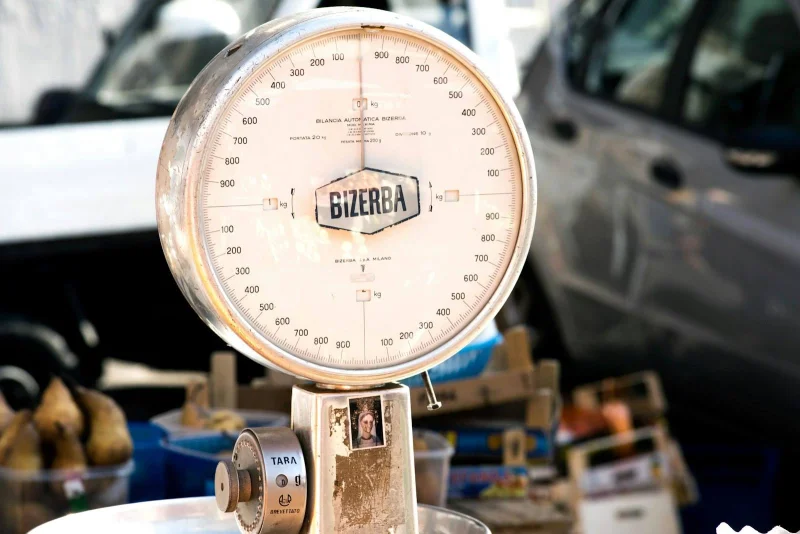
Newton's third law applied to scales — what you read on a bathroom scale is the normal force the floor exerts back on you, not your actual mass — which is why your "weight" reading changes in an elevator, on the Moon, and in different gravitational fields, while your mass stays exactly the same everywhere in the universe
The previous articles on this site covered weight unit basics (kg, lb, stone, tola), troy ounces and precious metals, and combat sport weight cutting dangers. This article addresses the physics of weighing scales — what bathroom scales, spring scales, and balance scales actually measure, and the specific contexts where the mass-vs-weight distinction has real practical consequences.
What a bathroom scale actually measures
A spring or digital bathroom scale measures force, not mass. When you stand on it, your body exerts a downward force (your weight, W = mg) on the scale's sensor. The scale's reading is calibrated to display this force as if it were a mass, using Earth's standard gravitational acceleration (g = 9.81 m/s²).
The conversion the scale performs internally: Displayed mass = Measured force ÷ 9.81
Why this works fine on Earth: gravitational acceleration varies only slightly across Earth's surface (approximately 9.78 m/s² at the equator to 9.83 m/s² at the poles, due to Earth's rotation and oblate shape) — a variation of about 0.5%, negligible for everyday purposes.
Why it fails elsewhere: the same scale taken to the Moon (g = 1.62 m/s², about 1/6 of Earth's) would measure your actual mass correctly via its spring or strain gauge, but its internal calibration (assuming Earth's g) would display a number 6× too small. A person with 70 kg mass would show as approximately 11.7 kg on an uncalibrated Earth scale used on the Moon.
Mass vs weight in elevators: the experience everyone has had
The "stomach drop" feeling in a fast elevator is a direct demonstration of weight changing while mass stays constant:
Elevator accelerating upward: the floor must exert more force on you to accelerate you upward along with the elevator. The scale reading (which measures this force) increases — you feel heavier.
Elevator accelerating downward: the floor exerts less force. The scale reading decreases — you feel lighter, sometimes momentarily approaching weightlessness if the deceleration matches free-fall acceleration.
Elevator at constant velocity (up or down): no acceleration means the normal force equals your standard weight exactly — same as standing on solid ground. This is why elevators feel normal once they reach cruising speed, even though they're moving.
The mathematics: apparent weight = m(g + a), where a is the elevator's acceleration (positive for upward acceleration, negative for downward). Your mass m never changes throughout this entire experience.
Weightlessness: why astronauts don't experience zero gravity
A common misconception: astronauts on the ISS experience "zero gravity." In reality, Earth's gravity at ISS altitude (approximately 400 km up) is only about 10% weaker than at the surface — gravity is still very much present.
What astronauts actually experience: the ISS is in continuous free-fall around Earth — it's falling toward Earth due to gravity, but moving fast enough sideways that it perpetually "misses" the ground, creating an orbit. Everything inside the station (including the astronauts) is falling at the same rate, producing the sensation of weightlessness — formally called "microgravity."
Why this matters for the mass-weight distinction: astronauts in microgravity have exactly the same mass as on Earth (their amount of matter hasn't changed), but their apparent weight (the force a scale would register) is effectively zero because nothing is providing a normal force against gravity — everything is in coordinated free-fall.
How astronauts measure their mass in space: since bathroom scales (which measure weight/force) don't work in free-fall, astronauts use specialized devices that measure mass via oscillation — a Body Mass Measurement Device uses a calibrated spring system; the astronaut's mass is calculated from how the spring's oscillation frequency changes with the astronaut attached (mass affects oscillation period; gravity doesn't).
Why "weightless" objects still have inertia
A common follow-up confusion: if astronauts are "weightless," does that mean objects in space are easy to move around?
No — mass still resists acceleration (inertia) regardless of weight. A massive object (like equipment or supplies) floating in microgravity requires the same force to accelerate as it would on Earth — F = ma applies regardless of gravitational context. Pushing a "weightless" 50 kg crate to get it moving, or stopping it once it's moving, requires exactly the same force as pushing a 50 kg crate on Earth (ignoring friction, which Earth has and space doesn't).
The practical danger this creates: astronauts have been injured by improperly secured equipment that, despite being "weightless," still carries its full mass and momentum when in motion. A floating tool that seems easy to handle can still cause significant injury if it collides with someone at speed — its mass (and therefore its momentum and kinetic energy) is unchanged from Earth.
Different planetary weights: the same mass, vastly different forces
Surface gravity across the solar system (relative to Earth's 9.81 m/s²):
| Body | Surface gravity (relative to Earth) | A 70 kg person would weigh (force equivalent) |
|---|---|---|
| Mercury | 0.38 | ~26.6 kg-equivalent |
| Venus | 0.90 | ~63 kg-equivalent |
| Earth | 1.00 | 70 kg |
| Moon | 0.166 | ~11.6 kg-equivalent |
| Mars | 0.38 | ~26.6 kg-equivalent |
| Jupiter (cloud top) | 2.36 | ~165 kg-equivalent |
| Sun (photosphere) | 27.9 | ~1,953 kg-equivalent |
The person's mass (70 kg) is identical in every row — only the gravitational force, and therefore the "weight" a scale would register, changes. This table is sometimes presented in popular science as "how much you'd weigh on other planets," which is a useful but technically imprecise framing — it's correctly understood as "how much gravitational force you'd experience."
How to use the Weight Converter on sadiqbd.com
- For everyday unit conversion: the converter handles standard mass unit conversions (kg, lb, stone, oz) — for Earth-surface contexts, these conversions work correctly because gravity is approximately constant across the conversion
- For scientific or physics contexts: remember that mass units (kg, lb as mass) and force units (Newtons, lbf) are conceptually different — the converter handles mass-to-mass conversions; force conversions require multiplying by the relevant gravitational acceleration
- For precious metals (troy ounces): as covered in the previous article, troy ounce conversions are mass-based and unaffected by gravitational context — gold's troy ounce mass is the same whether weighed on Earth or theoretically on the Moon, even though a Moon-calibrated Earth scale would misread it
Frequently Asked Questions
If I weigh myself at the equator and then at the North Pole, will I get a different number even on the same scale? Yes — by a small but measurable amount. Earth's gravity varies by location due to two factors: Earth's rotation (centrifugal effect reduces apparent gravity most at the equator) and Earth's oblate shape (the equator is farther from Earth's center than the poles, and gravity weakens with distance). The combined effect: gravity at the poles is approximately 0.5% stronger than at the equator. A person with 70.0 kg mass would show approximately 69.65 kg at the equator and 70.35 kg at the poles on a perfectly calibrated scale — a difference of about 700 grams, which is measurable on precise scales though imperceptible on typical bathroom scales. This is a real physical effect, not a measurement error.
Is the Weight Converter free? Yes — completely free, no sign-up required.
Try the Weight Converter free at sadiqbd.com — convert between kg, pounds, ounces, stone, tonnes, and troy ounces instantly.