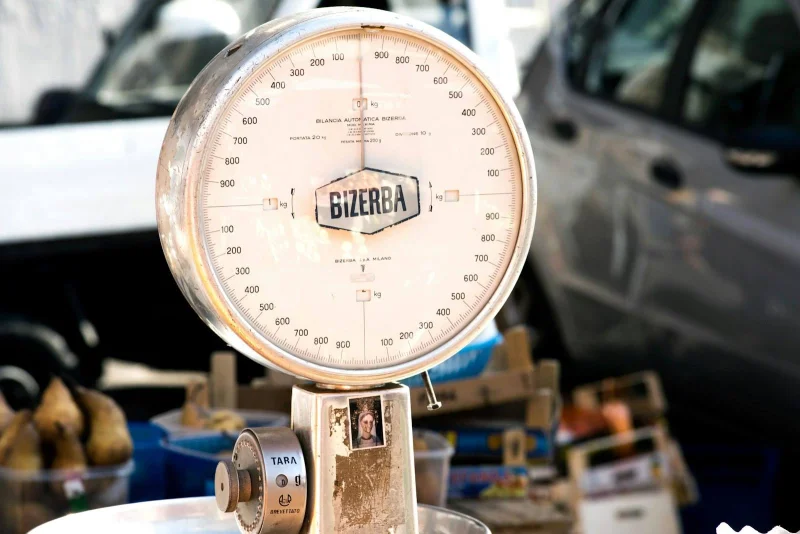
A kilogram and a pound are units of mass — but when you step on a bathroom scale, what you're actually measuring is weight (a force), and the scale converts it to kilograms or pounds using the assumption that you're standing on Earth's surface, where this conversion is approximately correct
The previous articles on this site covered weight unit basics (kg, lb, stone, troy ounces), troy ounces and gold pricing, and combat sports weight cutting. This article addresses mass vs weight as a conceptual distinction that matters in physics and engineering but is systematically obscured by everyday usage — and the practical consequences of this obscurity in specific real-world contexts.
The physics: mass vs weight are different things
Mass is the amount of matter in an object. It's measured in kilograms (SI unit), grams, pounds-mass, and similar units. Mass is an intrinsic property of an object — it doesn't change based on where the object is.
Weight is the gravitational force acting on a mass. It's measured in newtons (SI unit) or pound-force. Weight depends on the local gravitational acceleration: Weight (N) = Mass (kg) × g (m/s²), where g ≈ 9.81 m/s² on Earth's surface.
Everyday "weight" is actually mass. When someone says "I weigh 70 kilograms," they mean their mass is 70 kg — because kilograms are a unit of mass, not force. A 70 kg person would still "weigh 70 kg" (by mass) on the Moon, even though they'd experience only 1/6 of Earth's gravitational pull.
Why everyday language conflates them: bathroom scales measure the gravitational force on your body, then divide by Earth's g to display the result in kilograms — which is your mass. This works on Earth. On the Moon, the same scale (calibrated for Earth's g) would display a lower "weight" — not because your mass changed, but because the Moon's gravity is 1/6 of Earth's.
Where this matters: aerospace, medicine, and international standards
In most everyday contexts, mass-weight conflation doesn't cause problems because we're all on Earth's surface where g is approximately constant (varying by about 0.5% between the equator and the poles).
In aerospace engineering: a common engineering error source. "Pound" in particular is genuinely ambiguous — lb can mean pound-mass (lbm) or pound-force (lbf), and they're related by a specific factor that becomes critical in calculations. The NASA Mars Climate Orbiter (mentioned in the volume article) was lost partly because of pound-force vs newton confusion. Engineering standards organizations (ASTM, NIST) maintain explicit distinctions between lbm and lbf to avoid exactly this error.
In pharmaceutical dosing: drug doses are calculated by body mass (mg per kg of body mass), not weight. At Earth's normal gravity this is equivalent to using weight, but the distinction matters conceptually — the physiological parameter is the amount of drug per unit of tissue, which depends on mass distribution.
In calibration of scales: laboratory balances at high precision must account for local gravitational variation — a mass measured in London (g ≈ 9.816 m/s²) vs Kuala Lumpur (g ≈ 9.776 m/s²) would display differently on a force-measuring scale if not corrected. High-precision laboratory scales are calibrated with known reference masses at the specific location where they'll be used.
Stone: a unit used almost exclusively in the UK for human body weight
"Stone" (14 pounds = 6.35 kg) is used in the UK, Ireland, and a few other Commonwealth countries almost exclusively for describing human body weight — not for shipping, food, industrial weight measurement, or any other context.
This creates an odd specificity: a person in the UK describing their own weight says "I'm 11 stone 4" (11 stone and 4 pounds = 158 pounds = 71.7 kg). The same person describing the weight of their luggage says "it's 23 kilograms" or "it's 50 pounds" — not stones. Stone has been culturally reserved for the one application where it's still in common use.
Outside the UK and Ireland, stone is rarely used even in countries that otherwise use imperial units — Americans describe body weight in pounds, Australians in kilograms.
Tola: a historical unit in South Asian precious metals trading
The previous precious metals article covered troy ounces as the global standard for gold and silver trading. In South Asia (India, Pakistan, Bangladesh), the traditional unit for gold trading was the tola — originally defined as the weight of a silver British Indian rupee coin.
1 tola = 11.6638 grams (approximately 3/8 of a troy ounce).
Why it matters today: gold jewelry and investment gold in South Asian markets is still frequently quoted in tola, and buyers of Indian/Pakistani gold in international markets encounter tola prices. Misconverting tola to grams (or assuming 1 tola = 10 grams, a common rough approximation that's off by ~17%) leads to significant pricing errors when buying physical gold.
Metric ton vs imperial ton vs short ton: three different weights with similar names
The naming near-collision between the metric tonne and imperial tons is a persistent source of confusion in international trade and shipping:
Metric tonne (tonne): 1,000 kg = 2,204.6 lbs
US short ton: 2,000 lbs = 907.2 kg
UK long ton (imperial ton): 2,240 lbs = 1,016 kg
A shipment of "1,000 tons" is ambiguous without specifying which system — the three interpretations represent about 907 kg, 1,000 kg, and 1,016 kg respectively. In bulk commodity shipping and mining industries where "tons" are the dominant unit and quantities are in the millions, this ambiguity has commercial and legal significance. International contracts in these industries typically specify "metric tonnes" explicitly.
How to use the Weight Converter on sadiqbd.com
- For human body weight: verify which scale your source uses — UK/Ireland "stone" is body-weight-specific; US "pounds" is lbs (avoirdupois); most of the world uses kg
- For gold and precious metals: use troy ounces (the international standard), grams, or kilograms — troy ounces and grams are unambiguous; tola for South Asian markets requires the correct 11.6638g conversion factor, not a rounded 10g approximation
- For shipping/commercial weight: specify metric tonnes (1,000 kg) explicitly in international contexts; "ton" alone is ambiguous between the three systems and should be avoided in contracts or technical documents
Frequently Asked Questions
Why does the UK use stone for body weight but kilograms for everything else? Historical inertia, specifically for the human body weight context. The UK officially adopted metric measures decades ago, and kilograms are standard for food, shipping, science, and industry. But cultural change in personal contexts (how people describe their own body weight to each other) is slower than official adoption — generations of people who grew up knowing their weight in stone continue to use that unit colloquially, even if they use kilograms professionally. Younger generations are more likely to know their weight in kilograms, and the shift is gradual. This is a linguistic-cultural phenomenon, not a policy one — there's no official rule requiring stone to be used; it's simply what many people say, because it's what their parents said.
Is the Weight Converter free? Yes — completely free, no sign-up required.
Try the Weight Converter free at sadiqbd.com — convert between kg, pounds, stone, grams, troy ounces, and more instantly.