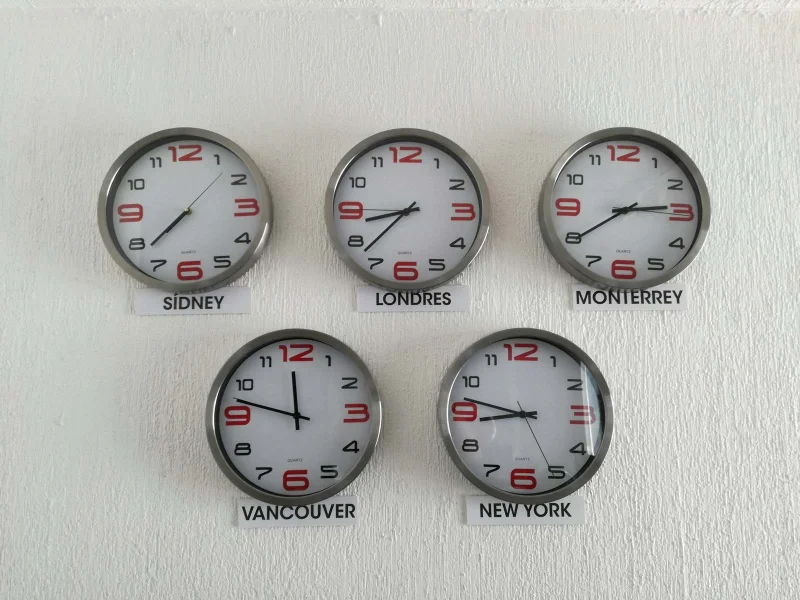
Time zones are one of the most silently damaging sources of scheduling errors
A meeting scheduled for "3 PM" between Dhaka and London works fine — until someone forgets that one city is observing Daylight Saving Time and the other isn't. A job interview booked for 9 AM EST that actually happens at 9 AM EDT. A server log that says an event happened at 2:30 when it actually happened at 8:30 because the timezone wasn't correctly specified. Time zone errors cost hours of missed meetings, failed deployments, and embarrassing scheduling conflicts.
A time zone converter resolves ambiguity by showing the exact local time in any city for any given moment.
How Time Zones Work
The Earth is divided into 24 primary time zones, each roughly corresponding to a 15-degree band of longitude (24 zones × 15° = 360°). Each zone is defined by its UTC offset — the number of hours ahead of or behind Coordinated Universal Time (UTC).
UTC (Coordinated Universal Time): The primary time standard. Unlike GMT (which is technically a timezone), UTC is a time standard not a timezone. For practical purposes, UTC and GMT are the same.
Bangladesh Standard Time (BST): UTC+6 — Bangladesh is 6 hours ahead of UTC. India Standard Time (IST): UTC+5:30 — note the 30-minute offset. Singapore/Malaysia/Philippines: UTC+8 UAE/Saudi Arabia: UTC+4 and UTC+3 respectively UK (winter): UTC+0 UK (summer, BST — British Summer Time): UTC+1 US Eastern (winter, EST): UTC−5 US Eastern (summer, EDT): UTC−4
Daylight Saving Time: The Hidden Variable
Many countries shift their clocks forward by 1 hour in summer (spring forward) and back in autumn (fall back). This is Daylight Saving Time (DST). Countries observing DST include the US, Canada, most of Europe, Australia (southern states), and others.
Bangladesh does not observe DST — Dhaka is always UTC+6, year-round. India also doesn't observe DST.
The problem: when scheduling with partners in DST-observing countries, the time difference changes by 1 hour twice a year (typically in March/April and October/November). A meeting that was conveniently scheduled when the difference was known becomes shifted without anyone explicitly changing anything.
Dhaka to New York difference:
- Winter (EST, UTC−5): 11 hours ahead
- Summer (EDT, UTC−4): 10 hours ahead
How to Use the Time Zone Converter on sadiqbd.com
- Enter the time — the hour and minute you want to convert
- Select the source timezone — where the event is scheduled "in"
- Select the target timezone(s) — where the other parties are located
- Read the local times — what the event time translates to in each location
The tool accounts for DST automatically — showing the correct offset for the given date.
Real-World Time Zone Scenarios
Remote team scheduling
A team has members in Dhaka (UTC+6), London (UTC+0 or UTC+1 with BST), and New York (UTC−5 or UTC−4 with EDT).
A meeting at 10:00 AM London time on a summer day (BST, UTC+1):
- Dhaka: 10:00 + (6−1) = 3:00 PM BST
- New York: 10:00 − (1+4) = 5:00 AM EDT
The New York team member has a 5 AM meeting — worth knowing before scheduling.
Finding a convenient overlap: 3 PM Dhaka (UTC+6) in summer:
- London: 3 PM − 5h = 10:00 AM BST (good)
- New York: 3 PM − 10h = 5:00 AM EDT (very early)
- Tokyo: 3 PM + 3h = 6:00 PM JST (fine)
3 PM Dhaka is the best compromise for Dhaka, London, and Tokyo — but breaks for New York.
International conference call scheduling
A webinar is scheduled for 2:00 PM UTC. What time is this in each region?
- Dhaka (UTC+6): 8:00 PM
- Dubai (UTC+4): 6:00 PM
- London (UTC+0 winter / UTC+1 summer): 2:00 PM / 3:00 PM
- New York (UTC−5 winter / UTC−4 summer): 9:00 AM / 10:00 AM
- Los Angeles (UTC−8 winter / UTC−7 summer): 6:00 AM / 7:00 AM
Specifying times in UTC for international communication removes DST ambiguity entirely.
Interpreting server logs
A server in UTC logs an error at 2024-06-10T08:15:00Z. What time was this locally in Dhaka?
UTC+6: 08:15 + 6h = 2:15 PM BST (Bangladesh Standard Time)
The error happened in the early afternoon locally — useful context for correlating with user reports or other events.
Flight arrival times
A flight departs Dhaka at 23:00 BST and arrives in Dubai at 02:30 AST (Arabia Standard Time, UTC+4) the next day. How long is the flight?
Departing 23:00 UTC+6 = 17:00 UTC Arriving 02:30 UTC+4 = 22:30 UTC next day? No — same day.
02:30 AST = 02:30 − 4h = 22:30 UTC (same day, not next day) Wait — departure was 23:00 BST = 17:00 UTC. Arrival 02:30 AST (+4) = 22:30 UTC (same calendar day UTC).
Flight duration: 22:30 − 17:00 UTC = 5 hours 30 minutes
UTC is the only common reference that makes cross-timezone flight calculations reliable.
UTC vs. GMT: What's the Difference?
GMT (Greenwich Mean Time) is a time zone — the time at the Prime Meridian in Greenwich, London. UTC (Coordinated Universal Time) is a time standard — maintained by atomic clocks, slightly more precise than GMT.
For everyday purposes: they're the same. UTC+0 = GMT. The distinction matters for extremely precise scientific applications where the leap second differences between GMT (astronomical) and UTC (atomic) are relevant.
Software and systems almost always use UTC rather than GMT, even when the offset is identical, because UTC is the formal international standard.
Tips for Time Zone Management
Store all timestamps as UTC. In databases, logs, and APIs, store times in UTC and convert to local time only at display. This prevents ambiguity and makes time arithmetic (sorting, comparing, subtracting) reliable.
Always specify the time zone when communicating internationally. "3 PM" is ambiguous; "3 PM UTC+6 / Dhaka time" is not. Include the UTC offset for clarity.
Check whether DST applies for the specific date, not the general rule. DST transitions happen on specific dates — usually the second Sunday in March and first Sunday in November in the US, and last Sunday in March/October in Europe. A meeting scheduled 3 weeks in advance may straddle a DST change.
Frequently Asked Questions
Does Bangladesh observe Daylight Saving Time? No — Bangladesh Standard Time (BST, UTC+6) is used year-round without seasonal adjustment.
What's the difference between UTC offset and a named timezone? A UTC offset (e.g. UTC+6) is unambiguous. A named timezone (e.g. "BST" for Bangladesh Standard Time, or "EST" for Eastern Standard Time) is ambiguous because the abbreviations are not globally standardised and may overlap. "BST" means British Summer Time (UTC+1) in the UK context and Bangladesh Standard Time (UTC+6) in Bangladesh. Always prefer UTC offset notation for clarity.
Is the time zone converter free? Yes — completely free, no sign-up required.
Time zones are simple in theory and surprisingly tricky in practice — especially across DST boundaries. The converter handles the arithmetic precisely so meetings, deployments, and international coordination don't fail on a UTC offset mistake.
Try the Time Zone Converter free at sadiqbd.com — convert any time between any timezones instantly, with DST handled automatically.