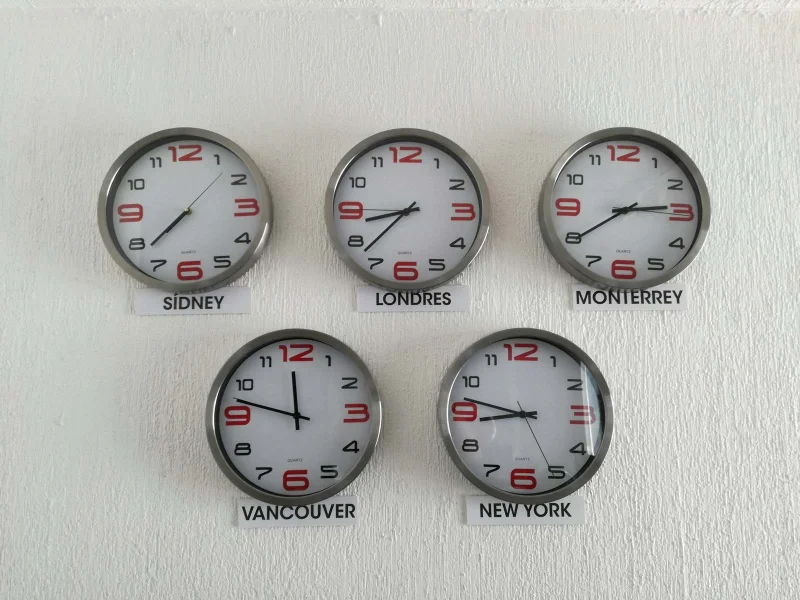
A 9 AM New York meeting costs a Singapore colleague their evening — and most meeting schedulers still don't think about this
The default mode of distributed team scheduling is: one person books a meeting at a time convenient for them and sends invites to everyone else. For a team spread across New York, London, Nairobi, and Singapore, this systematically privileges the person in whichever timezone books first — usually headquarters, usually somewhere in the US or Europe.
Understanding timezone arithmetic, the tools that handle it correctly, and the mental models for working across timezones produces fairer and more effective distributed teams.
The mental model: what's parallel vs sequential
The easiest way to visualise timezone relationships: think of time zones as a number line from UTC-12 to UTC+14, with each team member's work hours marked on it. Overlap between all marked blocks is the available meeting window.
Example — four-city team:
- New York: UTC-5 (EST), works 9am–6pm = UTC 14:00–23:00
- London: UTC+0 (GMT), works 9am–6pm = UTC 09:00–18:00
- Nairobi: UTC+3, works 9am–6pm = UTC 06:00–15:00
- Singapore: UTC+8, works 9am–6pm = UTC 01:00–10:00
Overlap: Singapore ends at UTC 10:00; London starts at UTC 09:00; New York starts at UTC 14:00. There is no window where all four cities are within standard hours simultaneously.
The best option: a window that requires the least sacrifice. UTC 09:00–10:00 has London in morning, Nairobi in morning/noon, Singapore at 5–6pm (manageable), but New York at 4am (untenable). UTC 14:00 has New York at 9am, London at 2pm, Nairobi at 5pm (marginal), Singapore at 10pm (poor). The "least bad" option depends on who you're willing to burden.
The rotating meeting approach for fair distribution
For truly global teams with no comfortable overlap, the rotating meeting approach ensures no single group is always inconvenienced:
Weekly rotation for a US-UK-APAC team:
- Week 1: 9am New York (2pm London, 10pm Singapore) — burdens APAC
- Week 2: 9am London (4am New York, 5pm Singapore) — burdens US
- Week 3: 9am Singapore (2am New York, 9am London) — burdens US/London
The principle: distribute the scheduling burden rather than concentrating it on the physically distant team members.
Timezone scheduling tools
World Time Buddy (worldtimebuddy.com): visual side-by-side timezone comparison with drag-to-find-overlap functionality. Free tier covers 4 cities.
Every Time Zone (everytimezone.com): clean linear visualisation of current time across all major zones. Good for quick "what time is it there now?" checks.
Calendly / Cal.com: shows available slots in the invitee's timezone automatically. Handles the "I offered 3pm on Tuesday" → "which timezone?" problem.
Google Calendar: shows events in each attendee's local timezone when creating events across timezones. The "world clock" in the side panel shows current times in multiple zones.
Temporal (api/code): when building applications that handle timezone-aware scheduling, the JavaScript Temporal API (now Stage 3 in TC39) handles timezone calculations correctly — addressing the decades of bugs in JavaScript's native Date object.
Daylight Saving Time: the biannual scheduling disruption
DST transitions are the most common cause of timezone calculation failures. The US and Europe transition on different weekends, creating a 2–3 week period where the usual offset between them is wrong by one hour.
US transitions (2025):
- Spring forward: March 9 (clocks advance 1 hour at 2am)
- Fall back: November 2 (clocks return at 2am)
UK/EU transitions (2025):
- Spring forward: March 30 (UK: 1am → 2am; EU: 2am → 3am)
- Fall back: October 26
The gap period: between March 9 and March 30, 2025, the US-UK offset is 4 hours (US is 4 hours behind instead of the usual 5). Anyone who has standing meetings with transatlantic colleagues knows this painful two-week period where "the 3pm meeting" changes time unexpectedly.
IANA timezone database: the standard reference for all timezone rules, including historical changes and DST transitions. All proper timezone handling in software should reference this database rather than hard-coding offsets.
Async-first communication and timezone etiquette
For teams that span more than 4–6 timezones, synchronous meetings become increasingly burdensome. The async-first approach minimises this:
Written communication default: use Slack/Teams messages, email, or documentation for anything that doesn't require real-time back-and-forth. A well-written message at 9am London time can be read and responded to at 9am Tokyo time — 9 hours later — with no one losing sleep.
Meeting for decision vs discussion: restrict synchronous meetings to decisions that genuinely require real-time discussion; use async processes (comment threads, recorded video explainers, decision documents) for everything else.
Record and share: record important meetings and share the recording with those in inconvenient timezones. They can watch at a convenient time and contribute asynchronously.
Timezone visibility: display teammates' timezones in Slack profile or Google Calendar availability. This reduces "let me check if they're online" back-and-forth.
How to use the Timezone Converter on sadiqbd.com
- Enter your local time and see what it is in any other timezone
- Find overlap windows — check 9am in one city against workday hours in others
- Verify DST transitions — check whether a timezone is currently in summer/winter time
Frequently Asked Questions
How do I convert "3pm London time" to my timezone automatically? Any calendar invite or scheduling tool that correctly supports timezones will do this automatically. When creating events, always specify the timezone explicitly (not just "3pm") — most tools default to the creator's timezone but this should be verified.
What is UTC and why don't we just all use it? UTC (Coordinated Universal Time) is the international time standard — all timezones are expressed as offsets from UTC. Using UTC for all global communication would eliminate the "which timezone did you mean?" ambiguity. It's used in aviation and international shipping. Cultural and circadian reasons mean converting local daily life to UTC universally is impractical.
Is the Timezone Converter free? Yes — completely free, no sign-up required.
Try the Timezone Converter free at sadiqbd.com — convert any time between any two timezones, with DST handling.