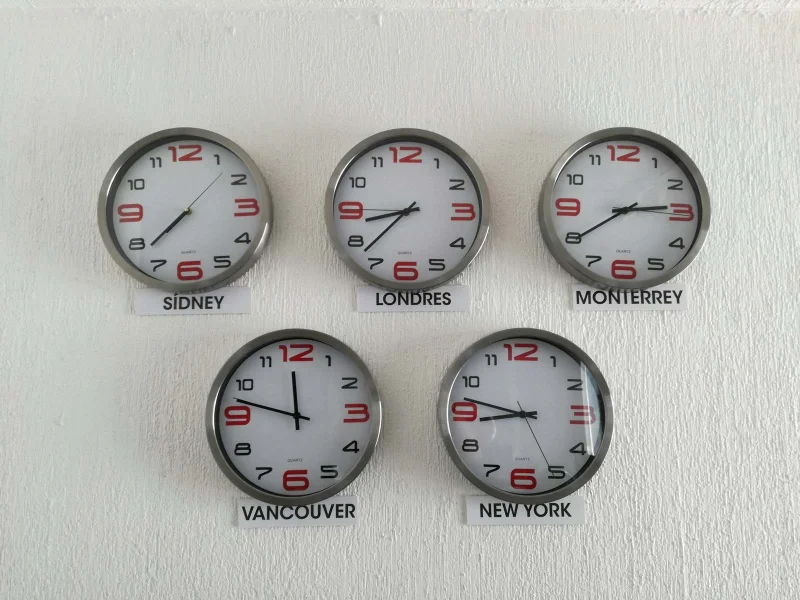
The world's strangest timezones make perfect sense once you understand the politics behind them
UTC+5:30 — India. UTC+5:45 — Nepal. UTC+9:30 — Australia's Northern Territory. UTC+12:45 — New Zealand's Chatham Islands. UTC+13 and UTC+14 — Pacific Islands. And then there's China, a country spanning what should be five time zones, operating entirely on a single one.
Timezones were supposed to be simple: one hour per 15 degrees of longitude, twenty-four zones for twenty-four hours. The reality reflects a century of political decisions, national unity considerations, and deliberate economic choices that have nothing to do with the sun.
Why half-hour and quarter-hour offsets exist
Mathematically, time zones should advance in one-hour increments as you move east. The sun moves 15 degrees of longitude per hour, and the planet can be divided into 24 neat hourly zones.
Several countries chose offsets that don't align with this pattern for specific reasons:
India (UTC+5:30): India spans about 30 degrees of longitude — from eastern Arunachal Pradesh near 97°E to western Gujarat near 68°E. This represents roughly two time zones of difference. Rather than split the country into two time zones (as geographically warranted), India chose a single time zone in 1947 at independence, compromising at +5:30 to avoid the discontinuity that had existed under British colonial management. A single time zone supports national unity — the same time everywhere strengthens the sense of one nation.
Nepal (UTC+5:45): Nepal set its timezone 15 minutes ahead of India specifically to differentiate from its larger neighbour and assert independence. This makes Nepal the only country in the world using a quarter-hour offset (UTC+5:45). The differentiation is partly symbolic — Nepal has a long history of guarding its independence from both India and China.
Australia's fractional zones:
- South Australia and Northern Territory: UTC+9:30 (halfway between UTC+9 and UTC+10, straddling the boundary)
- Lord Howe Island: UTC+10:30 standard, UTC+11 in summer — a permanent half-hour daylight saving offset
These reflect historical compromises when Australian states adopted time zones independently in the late 19th century.
Newfoundland, Canada (UTC-3:30): similar reasoning to India — a compromise between geographic position and practical convenience. Newfoundland was an independent dominion before joining Canada in 1949 and retained its historical timezone.
China's single timezone across a continent
China spans roughly 62 degrees of longitude — the equivalent of more than four hourly time zones, from UTC+5 in the westernmost Xinjiang region to UTC+8 in Beijing and the east coast.
Yet all of China operates on Beijing Time: UTC+8.
In Xinjiang (the westernmost region), solar noon — when the sun is directly overhead — occurs around 3 PM Beijing Time. Sunrise in summer can be as late as 10 AM by the clock. Working hours start in darkness and end in afternoon light.
The political reason: China adopted a single timezone in 1949 when the Communist Party consolidated power, as part of an emphasis on national unity. A fractured timezone map implied regional independence. One country, one time.
Practical consequence: Uyghurs in Xinjiang and some other western Chinese communities informally use "Xinjiang Time" (UTC+6) for local scheduling, particularly in rural areas. This creates a dual-time situation within the country.
The Pacific Islands and the date line
The International Date Line (approximately 180° longitude) creates the greatest timezone extremity. Crossing it going east moves the calendar back one day; going west advances it.
Samoa's date change: In 2011, Samoa moved from UTC-11 (nearly the last place on Earth to see the new day) to UTC+13 (one of the first). The reason: economic. Samoa's major trading partners are Australia and New Zealand. Operating on the opposite side of the date line meant Monday in Australia was still Sunday in Samoa, consuming two days of the working week in travel. The switch brought Samoa into alignment with its main economic partners.
Kiribati's date line anomaly: Kiribati (pronounced "Kiribas") is an archipelago nation whose islands span from UTC-12 to UTC+12 on either side of the date line. In 1995, Kiribati extended its eastern timezone to UTC+14 — creating a timezone that doesn't mathematically exist in the 24-hour system — so that the remote Line Islands could be in the same day as the rest of Kiribati and its main partner, Hawaii.
Why daylight saving time is so controversial
Daylight Saving Time (DST) was introduced in World War I as a fuel-saving measure. The idea: advancing clocks by one hour in summer shifts an hour of daylight from morning (when people sleep) to evening (when they're active), theoretically reducing evening lighting demand.
The arguments against it:
- The energy saving evidence is weak; modern lighting and air conditioning have changed the energy profile significantly
- The twice-yearly clock change is associated with increased heart attacks, traffic accidents, and productivity loss in the days immediately following
- Digital devices update automatically, but the disruption to sleep schedules and biological clocks is real
- It creates confusion in scheduling across timezone boundaries
Countries that have abolished DST: Russia (2014, permanently on standard time), Turkey (2016), most of Sub-Saharan Africa, China (never adopted it).
The EU voted to abolish DST in 2019 but the implementation has been delayed by member states' inability to agree on whether to stay permanently on standard time or summer time.
How to use the Time Zone Converter on sadiqbd.com
- Enter the time and source timezone — by city, timezone abbreviation, or UTC offset
- Select target timezone — any location in the world
- Convert — see the equivalent local time
- Useful for scheduling — international meetings, server log interpretation, travel planning
Frequently Asked Questions
What is UTC and why do developers use it instead of GMT? UTC (Coordinated Universal Time) is the primary time standard. GMT (Greenwich Mean Time) is technically a timezone observed in the UK during winter. They're the same offset (UTC+0) but UTC is more precisely defined using atomic clocks. Developers use UTC as a timezone-neutral reference because it has no daylight saving adjustment and is internationally standardised.
How do I handle timezone conversions in code correctly?
Store all timestamps in UTC in databases. Convert to local time only at display. Never store local time without the timezone offset. Use dedicated timezone libraries (pytz, zoneinfo in Python; Intl.DateTimeFormat in JavaScript) rather than manual offset arithmetic.
Is the Time Zone Converter free? Yes — completely free, no sign-up required.
Timezones are a political artefact as much as a geographic one. The boundaries, offsets, and daylight saving rules all reflect human decisions that made sense in their historical context — and continue to generate scheduling complications for anyone coordinating across them.
Try the Time Zone Converter free at sadiqbd.com — convert any time between any two timezones instantly.