A unit confusion once caused a $327 million spacecraft to crash into Mars
The Mars Climate Orbiter, launched in 1998 by NASA, was designed to enter orbit around Mars and study its climate. On September 23, 1999, it disappeared. The cause: one engineering team had been sending thruster data in imperial units (pound-force seconds) while another team's software expected metric units (newton-seconds). The trajectory calculations were off by a factor of 4.45. The spacecraft approached Mars at the wrong angle and was destroyed by atmospheric heating or flew off into space.
Unit confusion causes real consequences. In engineering and manufacturing, where precise measurement is the foundation of everything physical, it's a principle, not a curiosity.
Why metric dominates engineering globally
Three measurement systems exist:
SI (International System of Units / metric): the global scientific and engineering standard. Used in all scientific publications, international trade, and manufacturing in most of the world. Base units: metre, kilogram, second, ampere, kelvin, mole, candela.
Imperial (UK historical): inches, feet, yards, miles, ounces, pounds, stones, pints, gallons. The UK officially adopted SI in 1965; imperial units remain legal for retail and some informal contexts (road signs in miles, beer in pints).
US Customary: similar to imperial but with important differences in volume units (US gallon ≠ UK gallon; US pint ≠ UK pint) and some other measures. The United States has never mandated metrication despite multiple attempts.
Why engineers globally use metric:
- Decimal arithmetic: converting km to m is multiplication by 1,000. Converting miles to yards is multiplication by 1,760. The decimal system eliminates conversion arithmetic in calculations.
- Universal interoperability: global supply chains, international design collaboration, and scientific communication all work in SI.
- Physical laws are dimensionally consistent in SI: force = mass × acceleration → N = kg × m/s². In US customary, you need conversion constants.
Tolerances: the language of precision manufacturing
In manufacturing, a dimension is never just a number. A dimension is a number with a tolerance — the acceptable range of variation.
Tolerance notation:
25.00 mm ±0.05 mm means the dimension must be between 24.95 mm and 25.05 mm. Total tolerance range: 0.10 mm.
Alternatively, in limit format:
25.05 / 24.95 (upper limit / lower limit)
Or in ISO fits notation for shaft/hole assemblies:
25H7/f6 — a standardised tolerance system for mechanical fits
Common tolerance grades (ISO system):
| Grade | Typical tolerance (at 25mm) | Application |
|---|---|---|
| IT6 | ±0.013 mm | Precision engineering, gauges |
| IT7 | ±0.021 mm | Precision machine parts, bearings |
| IT8 | ±0.033 mm | Standard machined parts |
| IT9 | ±0.052 mm | Assembly parts |
| IT11 | ±0.130 mm | Rough machining |
Precision measurement tools and their resolution
The tool determines the measurement precision achievable:
Steel rule: ±0.5 mm. Sufficient for rough carpentry; insufficient for engineering.
Vernier calliper (manual): 0.02–0.05 mm resolution. The parallel graduation lines allow estimation to finer than the main scale.
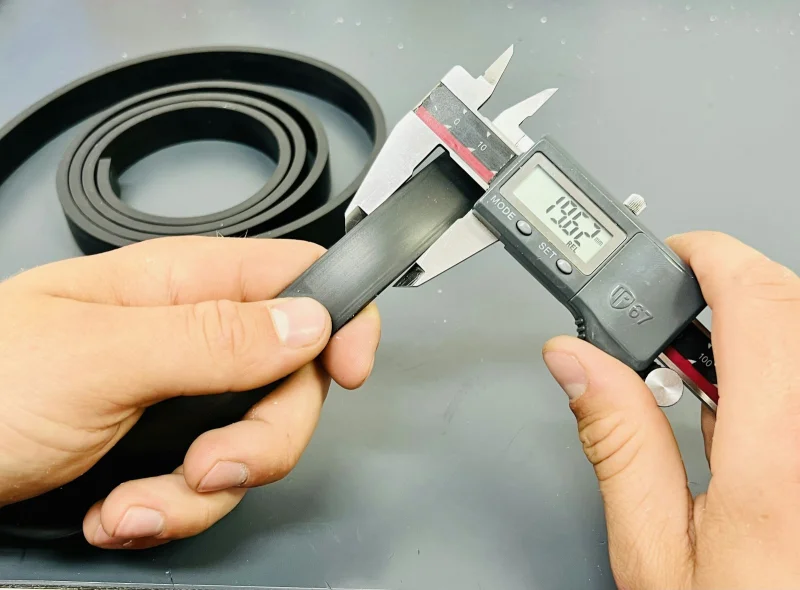
Digital calliper: 0.01 mm (10 microns) resolution. Suitable for most mechanical engineering work.
Micrometer screw gauge: 0.001 mm (1 micron) resolution. Required for precision shaft and bearing measurements.
Coordinate Measuring Machine (CMM): sub-micron accuracy. Used in aerospace and automotive manufacturing for complex 3D dimensions.
Laser interferometer: nanometre-level precision. Used in semiconductor manufacturing and optical system alignment.
CNC machining and dimensional tolerances
CNC (Computer Numerical Control) machining can achieve tolerances from ±0.025 mm for standard operations to ±0.005 mm for precision work with quality machines and appropriate fixturing.
Why tolerances matter in CNC:
A shaft must fit inside a bearing. The bearing has a specified inner diameter of 25.000 mm with tolerance +0.000/-0.010 mm. The shaft must be designed to fit: either a clearance fit (shaft smaller than hole, allowing rotation) or an interference fit (shaft slightly larger, pressed together for a permanent joint).
If the shaft is 25.012 mm (outside the bearing tolerance), it won't fit without forcing, which damages the bearing. If it's 24.985 mm (too loose), it allows unwanted play.
The engineer specifies both dimensions with tolerances that ensure correct fit under all manufacturing variation. This is the heart of tolerance stack-up analysis.
The US metrication problem
The US has attempted metrication several times. The Metric Conversion Act of 1975 made metrication official policy but voluntary. The Omnibus Trade and Competitiveness Act of 1988 designated metric as the preferred system for federal agencies. Yet the US remains primarily non-metric in everyday life.
Why metrication stalled in the US:
- No mandate: all metric laws were voluntary
- Infrastructure cost: road signs, tools, machinery — replacing all of this simultaneously is enormously expensive
- Cultural inertia: three generations of Americans grew up with imperial units
- Trade relationships: US manufacturing exports to Canada and Mexico adapted to accommodate metric; domestic market pressure was limited
Why it matters in practice: US engineers working with international partners constantly convert between unit systems. CAD software handles this, but the mental overhead — and the occasional conversion error — persists.
How to use the Length Converter on sadiqbd.com
- Enter the length and source unit — mm, cm, m, km, inches, feet, yards, miles, nautical miles
- Convert — see equivalents across all length units
- Apply to your context — construction (feet/inches and mm), engineering (mm and inches), geography (km and miles)
Frequently Asked Questions
What is a mil (or thou) and when is it used? A mil (thousandth of an inch, 0.0254 mm) is commonly used in US manufacturing, PCB design, and materials specifications. A 10 mil trace on a circuit board is 0.254 mm wide. The mil is common in technical documentation even in countries that otherwise use metric.
What's the difference between a UK mile and a US mile? They're the same — both the UK and US use the international mile of exactly 1,609.344 metres. The confusion arises with volume: US gallon and UK gallon are different, but the mile is identical.
Is the Length Converter free? Yes — completely free, no sign-up required.
Measurement precision is foundational to everything physical that gets built. Understanding tolerances, unit systems, and why they matter makes the length converter more than a lookup tool — it's part of the language of making things.
Try the Length Converter free at sadiqbd.com — convert between mm, cm, metres, km, inches, feet, yards, and miles instantly.