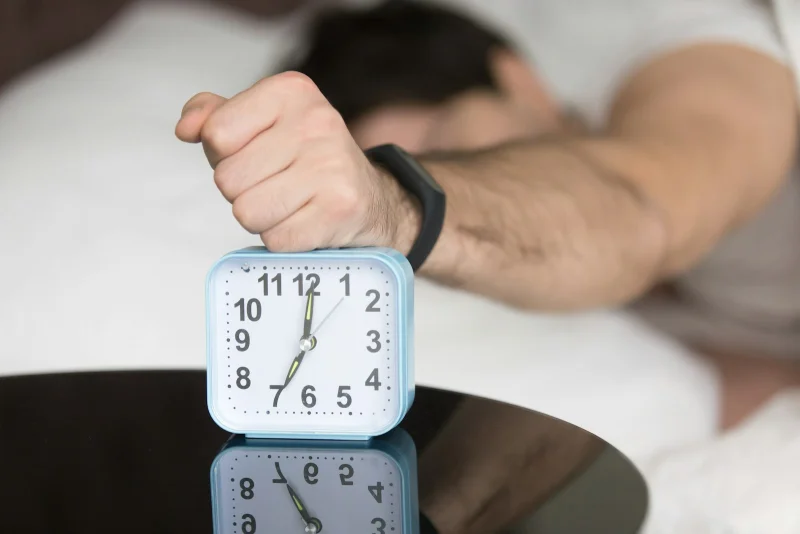
You can't actually catch up on sleep — and the belief that you can is making things worse
Saturday morning. You slept until 10 AM to make up for a rough week. You feel better. You tell yourself the debt is cleared.
It isn't.
Sleep debt is real. The recovery benefits of a lie-in are real. But the research on catching up is clear: weekend sleep recovery restores subjective alertness (you feel better) far more completely than it restores objective cognitive performance, metabolic health, and the biological damage from sleep restriction. The feeling of being caught up is not the same as being caught up.
How sleep debt accumulates
Sleep debt is the cumulative deficit between the sleep you need and the sleep you get. It builds across nights.
The standard recommendation: 7–9 hours for adults (National Sleep Foundation and the American Academy of Sleep Medicine). Below 7 hours consistently is defined as insufficient for most adults.
What happens across a restricted week:
- Night 1 at 6 hours: 1–2 hours of deficit
- Night 2: deficit accumulates
- Night 5: cumulative deficit of 5–10 hours
By Friday, cognitive performance, reaction time, and mood are significantly impaired — even as people adapt to the feeling of tiredness and underestimate how impaired they are. Research by Hans Van Dongen and colleagues found that after 14 days at 6 hours of sleep, participants performed as badly on cognitive tests as people who had been awake for 24 hours straight — yet reported feeling "only slightly sleepy."
What sleep restriction actually does to the body
The cognitive effects get the most attention, but the metabolic and physiological effects are equally significant:
Glucose metabolism: a single week of sleep restriction to 6 hours per night is sufficient to impair insulin sensitivity in healthy young adults. A study by Spiegel, Leproult, and Van Cauter found that after one week of sleep restriction, glucose metabolism markers resembled those of prediabetes.
Appetite hormones: sleep restriction increases ghrelin (hunger hormone) and decreases leptin (satiety hormone). A study in PLOS Medicine found that people sleeping 5 hours per night had 15% higher ghrelin and 15% lower leptin than those sleeping 8 hours — along with significantly increased appetite, preferentially for calorie-dense foods.
Cardiovascular risk: chronic sleep restriction is associated with elevated blood pressure, increased C-reactive protein (inflammation), and higher cortisol levels. The association between short sleep duration and cardiovascular events is significant in large epidemiological studies.
Immune function: sleep is when the immune system does much of its maintenance work. Matthew Walker's research found that even moderate sleep restriction significantly reduces natural killer cell activity — the immune cells that fight viruses and cancer cells.
The weekend recovery problem
The instinct to sleep in on weekends to compensate for the week makes sense. And it does help — partially.
A 2019 Penn State study found that weekend recovery sleep partially but incompletely restored metabolic parameters impaired by weekday sleep restriction. Total calorie intake remained elevated (the appetite disruption didn't fully reverse). Insulin sensitivity improved but didn't fully recover.
A 2019 Current Biology study found similar results: participants on a weekend recovery schedule showed improvement in some markers but not others compared to chronic sleep restriction without recovery. And critically, the recovery benefits didn't persist through the following week of restriction — each Monday, the debt began accumulating again.
Social jetlag: irregular sleep schedules — sleeping and waking at consistent times on weekdays but shifting significantly on weekends — create a recurring disruption similar to crossing time zones weekly. This "social jetlag" is associated with higher rates of obesity, metabolic syndrome, and depressive symptoms, independently of total sleep duration. The inconsistency itself causes harm.
Sleep stages and why they all matter
A complete sleep architecture includes:
NREM Stage 1 (light sleep): transition from wakefulness. 5% of total sleep. Easily disrupted.
NREM Stage 2: cardiovascular repair, body temperature drops, memory consolidation begins. 50–55% of sleep.
NREM Stage 3 (slow-wave/deep sleep): the most physically restorative stage. Growth hormone is secreted. Cellular repair, immune function, glucose regulation. Harder to get out of — if woken here, sleep inertia is strong.
REM sleep: memory consolidation, emotional processing, creativity. Dreams occur here. Amount of REM increases in later sleep cycles — which is why cutting sleep short consistently eliminates disproportionately more REM than deep sleep.
A full sleep cycle is approximately 90 minutes. Adults cycle through roughly 4–6 complete cycles per night. Waking at the end of a cycle — in light NREM or transitioning — reduces sleep inertia. Waking mid-cycle (especially from deep sleep) produces groggy, heavy waking.
The 90-minute cycle and the sleep calculator
The Sleep Calculator on sadiqbd.com uses the 90-minute sleep cycle to calculate optimal bedtimes or wake times.
If you need to wake at 7:00 AM: Working backwards in 90-minute increments:
- 7:00 AM → 5:30 AM → 4:00 AM → 2:30 AM → 1:00 AM → 11:30 PM → 10:00 PM
11:30 PM provides 5 complete 90-minute cycles (7.5 hours). 10:00 PM provides 6 cycles (9 hours). Both hit cycle boundaries and are preferable to 11:00 PM (which ends mid-cycle at 7:00 AM).
The 15-minute buffer: falling asleep typically takes 10–20 minutes. Add 15 minutes to the target bedtime to account for sleep onset.
What actually improves sleep quality
Research-backed sleep hygiene, ranked roughly by evidence strength:
Consistent sleep and wake times (highest impact): your circadian rhythm is a biological clock that runs on consistency. Going to bed and waking at the same time daily — including weekends — stabilises the clock and improves sleep quality more than almost any other intervention.
Light exposure: bright natural light in the morning advances the circadian clock; bright light in the evening delays it. Avoiding bright artificial light (especially blue-spectrum screens) 1–2 hours before bed reduces melatonin suppression. Morning sunlight within an hour of waking is one of the most effective circadian anchors.
Temperature: core body temperature drops 1–2°C at sleep onset. A cool sleeping environment (18–19°C / 65–66°F) facilitates this drop. A hot shower or bath paradoxically helps — it causes peripheral vasodilation that accelerates core cooling after you get out.
Caffeine timing: caffeine has a half-life of 5–6 hours and blocks adenosine receptors — the mechanism that creates sleep pressure. A 3 PM coffee still has roughly half its caffeine at 8 PM. Cutting off caffeine by 1–2 PM improves sleep quality for most people.
Alcohol: alcohol assists sleep onset but fragments sleep architecture, reducing REM and increasing waking in the second half of the night. Many people sleep worse overall after alcohol despite falling asleep faster.
How to use the Sleep Calculator on sadiqbd.com
To find your optimal bedtime:
- Enter your required wake time
- The calculator shows optimal bedtimes at 90-minute cycle boundaries
- Account for 15 minutes of sleep onset time — go to bed 15 minutes before the target
To find your optimal wake time:
- Enter your planned bedtime
- The calculator shows wake times that correspond to cycle boundaries
- Aim for the time that gives you 5–6 complete cycles (7.5–9 hours)
Frequently Asked Questions
Is 7 hours enough or do I need 8? Sleep need is somewhat individual — a genuine 7-hour sleeper exists, but is less common than self-report suggests. Research by Matt Walker and others suggests fewer than 3% of people are truly functional on less than 7 hours. If you wake naturally (without an alarm) after a week of unrestricted sleep, that duration is likely your actual need.
Why do I feel worse after sleeping too long? Oversleeping (beyond your natural need) is associated with grogginess and lower energy — sometimes from waking mid-cycle, sometimes from disruption to the circadian rhythm. Social factors (staying up too late then compensating) often explain it.
Does napping count toward sleep debt repayment? Partially. A 20–30 minute nap improves alertness, mood, and performance without causing significant sleep inertia. Longer naps (60–90 minutes) include deeper sleep stages and provide more substantial recovery but can interfere with night sleep if taken too late. Napping is a useful tool but doesn't fully substitute for consolidated night sleep.
Is the Sleep Calculator free? Yes — completely free, no sign-up required.
Sleep debt is cumulative and only partially repayable. The most effective strategy isn't managing debt through weekend recovery — it's minimising accumulation through consistent, sufficient sleep during the week.
Try the Sleep Calculator free at sadiqbd.com — find your ideal bedtime or wake time based on 90-minute sleep cycles, tonight.