Two People, One Hour, Very Different Numbers
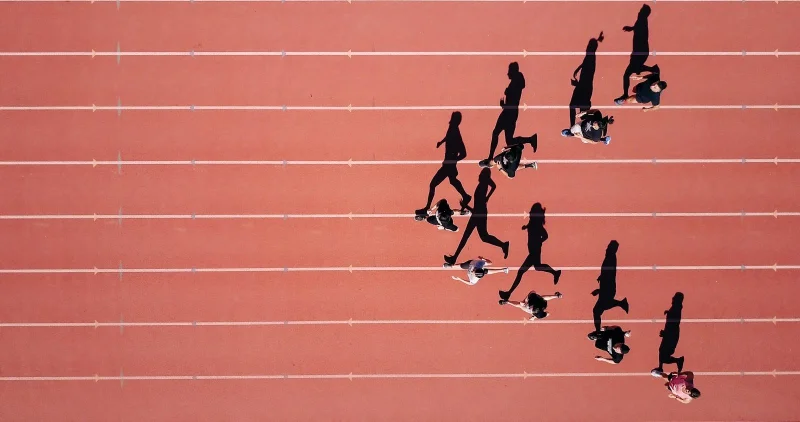
A 90 kg person and a 60 kg person go for the same one-hour run at the same pace. The heavier runner burns roughly 50% more calories.
Same two people go for a one-hour bike ride on flat ground at a moderate pace. The gap shrinks considerably.
Same two people swim laps for an hour. The relationship gets messier still — and in some cases the lighter, more technically efficient swimmer burns less despite covering more distance.
Body mass affects your calorie burn in different activities by wildly different amounts, and understanding why lets you read any estimate far more critically.
Weight-Bearing vs Supported Activity
The distinction that explains most of it: is your body mass the load you're moving?
Weight-bearing activities
Walking, running, hiking, stair climbing, most field sports. Every step lifts your entire body mass against gravity and then absorbs it on landing. Double the mass, roughly double the mechanical work.
This is why the standard MET-based formula works reasonably well here:
calories per minute = MET × 3.5 × body weight in kg / 200
The linear relationship with body weight is baked into that formula, and for weight-bearing activity it's a decent model. Running at a 6-minute-per-kilometre pace is around 9.8 METs. For the 90 kg runner that's about 15.4 kcal/min; for the 60 kg runner about 10.3.
A useful field approximation for running: roughly 1 kcal per kilogram per kilometre, largely independent of pace. Running 10 km at 70 kg costs about 700 calories regardless of whether you take 50 minutes or 70. Pace changes the rate, not much the total.
Supported activities
Cycling, rowing, swimming. Your body weight is held up by a saddle, a seat, or water. The work you do goes into overcoming resistance — air, rolling friction, drag — rather than lifting yourself.
Cycling on flat ground is dominated by aerodynamic drag, which scales with frontal area and the cube of speed. A heavier rider has somewhat more frontal area, but not proportionally more, so the relationship with body mass is much weaker than in running. Two riders of very different weights holding the same speed on flat ground burn far more similar amounts than the MET formula suggests.
Go uphill and it flips. Climbing means lifting body mass plus bike against gravity, and mass matters enormously again. This is exactly why professional climbers are small and time-triallists on flat courses generally aren't.
Swimming is the odd one out. Water supports your weight entirely, and energy cost is dominated by drag and technique. A skilled swimmer with good body position slips through the water; a poor swimmer with dragging legs fights it. The difference in energy cost between an efficient and inefficient swimmer at the same speed can be enormous — larger than the difference body mass makes.
Where MET Values Fall Down
METs are defined as multiples of resting metabolic rate, where 1 MET is roughly 3.5 ml of oxygen per kg of body mass per minute. That per-kilogram definition is where the linear weight scaling comes from.
The problems:
Resting metabolic rate isn't exactly 1 MET for everyone. The 3.5 ml/kg/min figure is a population average. Actual resting oxygen consumption varies with body composition and age, and it tends to be lower per kilogram in heavier individuals because fat mass is less metabolically active than lean mass. This means MET-based estimates systematically overestimate for people with higher body fat.
Fat mass doesn't consume much oxygen but does have to be carried. In weight-bearing activity that's fine — the mechanical cost is real. In supported activity, you're crediting metabolic activity to tissue that isn't producing it.
METs ignore efficiency entirely. Two cyclists at 150 watts of output burn similar calories regardless of skill. Two swimmers at the same speed may not, because the output required differs.
Terrain and load are invisible. A MET value for "hiking" doesn't know whether you're on a flat towpath or a 15% grade with a 15 kg pack.
Load, Grade and the Things That Actually Change the Number
Beyond body mass, four factors shift the burn substantially and rarely appear in calculators.
Gradient. Walking uphill is dramatically more expensive than walking on the flat. Going from level ground to a 10% incline at the same speed can more than double the energy cost. Downhill is cheaper metabolically but involves eccentric muscle work that causes soreness — the cost shows up later, not in the calorie count.
Carried load. A backpack adds to the mass you're lifting. For weight-bearing activity, adding 10 kg of pack to a 70 kg person raises the energy cost by roughly the ratio of total masses — about 14%. Loads carried close to the body's centre of mass cost less than loads held out at arm's length.
Surface. Sand, deep snow, loose gravel and rough trail all raise energy cost meaningfully compared to a paved path. Soft-surface running has been estimated to cost noticeably more than road running at the same pace.
Wind and drafting. Almost irrelevant when walking, decisive when cycling. Riding in another rider's slipstream can cut power requirements substantially at speed.
Using the Calculator With That in Mind
The Calories Burned Calculator uses MET values and your body weight:
- Select the activity from the list.
- Enter your body weight.
- Enter the duration.
- Read the estimated calorie burn.
Then apply the corrections you know about:
- Weight-bearing activity on flat ground at moderate intensity: the estimate is probably reasonable, maybe slightly high.
- Supported activity like flat cycling: if you're substantially heavier than average, the estimate is likely too high.
- Hills, load, or rough terrain: the estimate is likely too low. Choose a higher-intensity variant of the activity if the list offers one.
- Swimming: treat the number as very approximate unless you know your technique is efficient.
And regardless of activity, remember the calculator gives gross expenditure. You would have burned resting calories during that hour anyway — roughly 60 to 90 depending on your size. Net exercise cost is the figure minus that.
Common Mistakes
Eating back the full estimate. Between MET overestimation, the gross-versus-net issue, and the tendency to overestimate duration and intensity, the number is usually optimistic. Treating it as an eating allowance reliably stalls progress.
Comparing your total against someone else's. A heavier person burning more calories for the same workout isn't training harder. They're moving more mass.
Assuming the number falls as you lose weight because you're less fit. It falls because there's less of you to move. Same run, smaller person, fewer calories. That's arithmetic, not regression.
Ignoring the strength training gap. MET values for resistance training are poor at capturing what's actually happening, because the metabolic cost during the session is only part of the story.
Double counting with a tracker. If your watch already logged the session, don't add a calculator estimate on top.
FAQ
Do heavier people burn more calories doing the same exercise? In weight-bearing activity, substantially more — the relationship is close to proportional. In supported activity like flat cycling and swimming, considerably less so.
Does running faster burn more calories per kilometre? Only modestly. Total cost per kilometre is roughly constant across a wide range of paces; running faster mainly compresses the same energy expenditure into less time.
How much does a hill add? A lot. Grade is one of the largest single modifiers of energy cost in walking and running, and most calculators don't account for it at all.
Why do swimming estimates vary so much? Because energy cost in water is dominated by drag and technique rather than body mass. Efficiency differences between swimmers are larger than in almost any other activity.
Should I trust my watch or the calculator? Both carry meaningful error. Use either consistently to track relative change over time rather than treating any figure as an absolute measurement.
The Takeaway
Whether your body weight is the load or just along for the ride determines how much a calorie estimate depends on your size — and standard MET formulas apply the same linear weight scaling to both cases. Knowing which category your activity falls in, and whether hills or a pack are involved, tells you which direction the estimate is wrong in.
Estimate calories burned across dozens of activities free with the Calories Burned Calculator at sadiqbd.com — no sign-up, instant results. For exercise guidance tailored to your health status, consult a qualified professional.