A cheetah can't outsprint a horse over a mile — and the physics of why explains every speed record in nature
The cheetah (120 km/h peak sprint) is not the fastest animal overall. A peregrine falcon in a stoop dive reaches 320 km/h. A sailfish swims at 110 km/h. But none of these animals can maintain their peak speed for long. The relationship between speed and endurance, the physics of locomotion, and why different body designs optimise for different points on the speed-endurance curve reveals as much about biomechanics as any laboratory study.
Animal speed records in context
Peak sprint speeds (measured or estimated):
| Animal | Peak speed | Notes |
|---|---|---|
| Peregrine falcon (dive) | 320 km/h (200 mph) | Gravity-assisted; not powered flight |
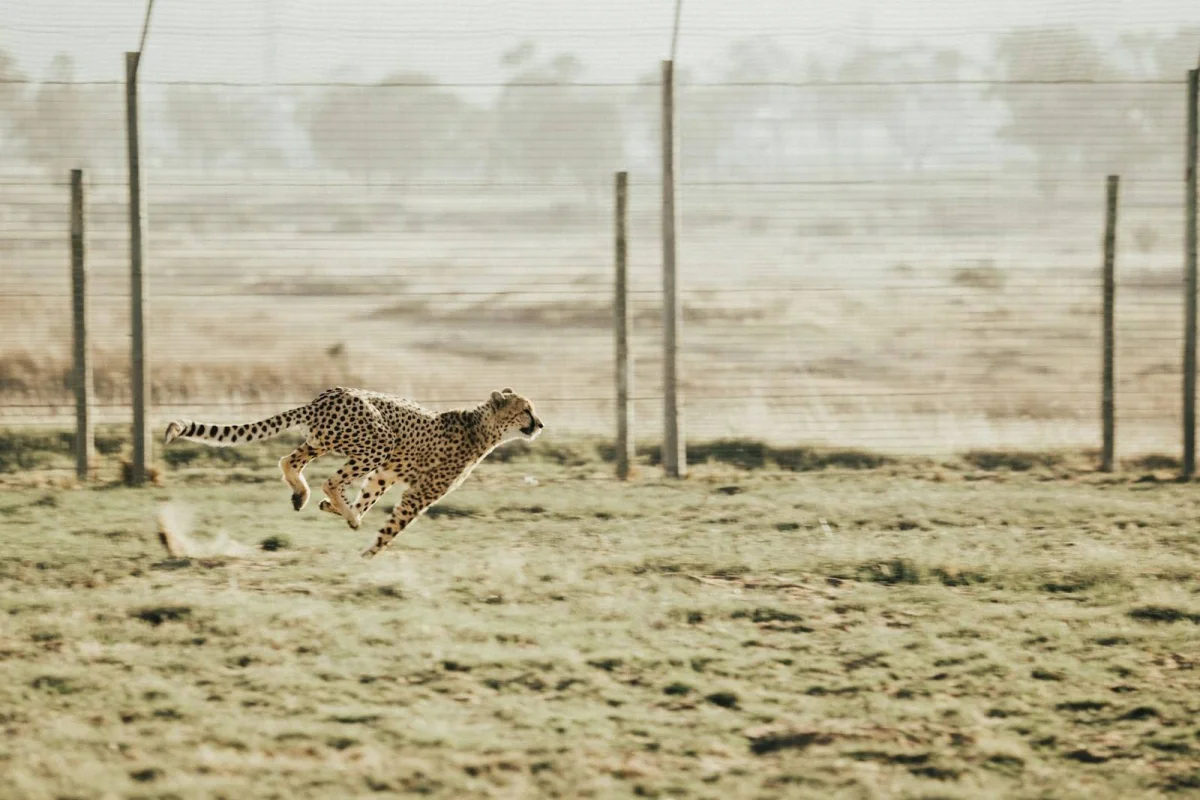
| Cheetah | 112–120 km/h (70–75 mph) | Maintained for 20–30 seconds max |
| Sailfish | 110 km/h (68 mph) | Short bursts |
| Pronghorn antelope | 88 km/h (55 mph) | Sustained for km; fastest land endurance |
| Lion | 80 km/h (50 mph) | Sprint only; poor endurance |
| Thoroughbred horse | 70 km/h (43.5 mph) | Can sustain for 1–2 km |
| Greyhound | 72 km/h (45 mph) | Sprint-optimised domesticated dog |
| Wildebeest | 50 km/h (31 mph) | Very good endurance |
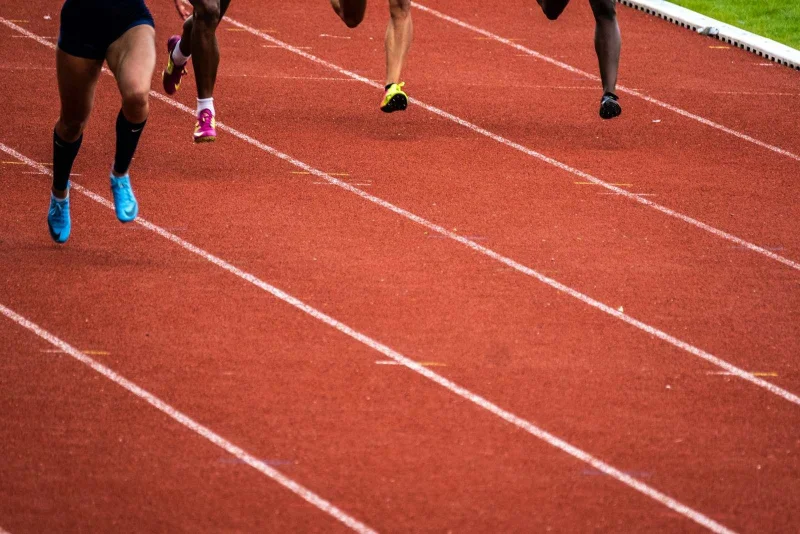
| Human (Usain Bolt) | 44.72 km/h (27.8 mph) | 60–100m bursts |
| Human (elite marathon) | ~20 km/h (12.5 mph) | 42km sustained |
Why cheetahs sprint fast but tire quickly
The cheetah is the ultimate sprint specialist. Its speed comes from:
- Enlarged adrenal glands providing burst adrenaline
- Semi-retractable claws for traction (unique among cats)
- Flexible spine acting as a spring — spinal flexion and extension doubles effective stride length
- Very high stride frequency and long stride length simultaneously
The metabolic cost: at 100+ km/h, the cheetah's body temperature rises approximately 1°C per minute. After 30 seconds, heat stress forces the cheetah to stop regardless of prey status. It may take 20–30 minutes to cool down before eating.
This is why cheetahs have approximately a 50% hunt success rate — they sometimes have to abandon a kill they've successfully caught because they're too hot to fight off other predators.
The pronghorn's endurance advantage
The pronghorn antelope (North America) is slower than a cheetah at peak speed but is the world's fastest long-distance runner. It can sustain 88 km/h for nearly a kilometre, and can run at 56 km/h for several kilometres.
This is thought to be an evolutionary adaptation to the now-extinct North American cheetah (Miracinonyx) — the pronghorn evolved endurance speed that a cheetah-equivalent predator couldn't match.
The physiology: oversized windpipe, large trachea and lungs relative to body size, high mitochondrial density in muscles. Pronghorns have a VO2max approximately 3× that of similarly sized animals.
Human speed and endurance
Humans are unusual among mammals: poor sprinters (44.7 km/h peak) but elite endurance runners by mammalian standards. The "persistence hunting" hypothesis suggests pre-agricultural humans exploited this: tracking prey over hours in heat, causing it to overheat and collapse.
The thermoregulation advantage: humans sweat to cool, rather than panting (which requires slowing down). This allows humans to maintain running speed over long distances in heat that would cause other animals to overheat.
Metabolic efficiency of running: humans are approximately 65–70% efficient at converting metabolic energy to forward movement at optimal speeds (slower than their maximum). This is comparable to horses.
Speed in water: why fish are slower than they seem
Water is approximately 800× denser than air. Aquatic locomotion faces enormous drag. Despite this, sailfish reach 110 km/h — but only in brief bursts.
Drag scaling: drag force ∝ velocity². A fish swimming at 10 km/h faces 4× the drag it faces at 5 km/h. The power required increases with the cube of velocity — doubling speed requires 8× the power. This is why fish must produce enormous short-term power for speed but cannot sustain it.
Streamlining: tuna, marlin, and sailfish are the apex of aquatic streamlining — nearly perfectly optimised teardrop cross-sections. A bluefin tuna can sustain 70 km/h indefinitely over long migrations.
The physics of legged locomotion
Stride frequency and stride length both contribute to speed: Speed = stride length × stride frequency
Most animals reach their speed limit because either:
- Muscles can't contract faster (stride frequency limit)
- Limbs can't swing further in one stride (stride length limit)
The cheetah breaks stride length limits with spinal flexion. Horses evolved long leg bones for stride length. Greyhounds have both long legs and high stride frequency.
Galloping and the elastic energy of tendons: horses and cheetahs gallop using a "spring-mass" model — tendons store and release elastic energy like springs, reducing the metabolic cost of each stride. An estimated 70% of the elastic energy stored in equine tendons is recovered in the next stride.
How to use the Speed Converter on sadiqbd.com
- Convert animal speeds — from km/h to mph or m/s for comparison
- Contextualise human performance — how does your race pace compare in km/h or mph?
- Convert racing records — between metric and imperial for international comparisons
Frequently Asked Questions
What is the fastest recorded human running speed? Usain Bolt's peak speed during his 2009 world record 100m (9.58 seconds) was recorded at 44.72 km/h (27.78 mph), reached around the 60–80m mark. His average speed for the full 100m was 37.58 km/h.
Could a human ever outrun a horse over a very long distance? Yes — in some races. The Man vs Horse Marathon in Llanwrtyd Wells, Wales has been held since 1980. Humans have occasionally beaten horses, most often in very warm conditions where human thermoregulation advantages outweigh the horse's speed and endurance.
Is the Speed Converter free? Yes — completely free, no sign-up required.
Try the Speed Converter free at sadiqbd.com — convert between km/h, mph, m/s, knots, and Mach for any animal, vehicle, or athletic performance.