A room advertised as "20 square metres" in one country and "20 square metres" in another might not be the same size at all — because the standard for what counts as "floor area" varies by country, measurement method, and even by which parts of a sloped ceiling count
The previous articles on this site covered area unit basics, land measurement around the world, property floor area (GIA/NIA), and cross-country property price comparison. This article addresses area measurement in agriculture and environmental science — specifically, why the hectare became the global standard for land area, what "10,000 square metres" actually represents at farm scale, and the specific area measurements used for environmental and conservation work.
Why the hectare: the metric system's deliberate agricultural unit
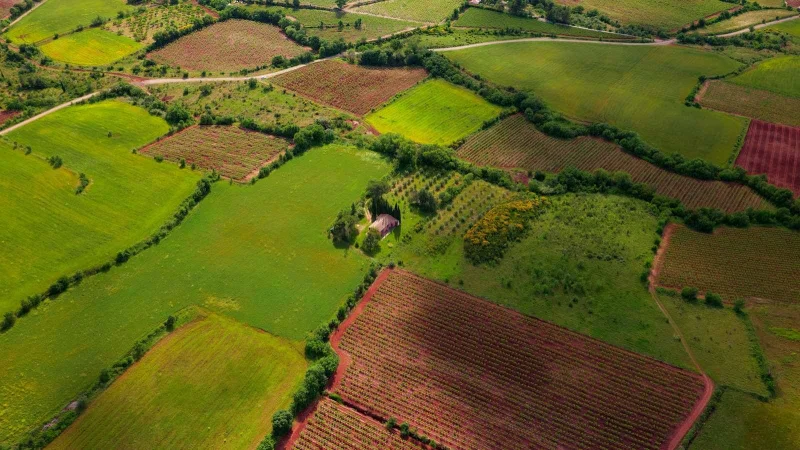
The hectare (100m × 100m = 10,000 m²) was introduced alongside the metric system specifically to provide a convenient large area unit for agricultural use — sitting between the square metre (too small for farm fields) and the square kilometre (too large for typical field sizes).
The design intention: a hectare is a useful "human scale" agricultural unit. An average family farm in Western Europe is typically 10-100 hectares; individual field sizes are often 1-20 hectares; a large commercial farm might be 1,000+ hectares.
The acre (4,047 m²) is almost exactly 0.405 hectares — close enough that farmers and surveyors can roughly convert in their heads (1 hectare ≈ 2.47 acres), and agricultural data is often presented in both units in international reports.
Carbon sequestration and deforestation: area measurement in environmental contexts
Environmental science uses area measurements at scales from individual plots to global totals:
Carbon sequestration rates are expressed in tonnes of CO₂ equivalent per hectare per year — a standard expression for comparing different land types' carbon-capture capacity. Tropical forest sequesters roughly 2-10 t CO₂/ha/year; temperate forest 1-3 t CO₂/ha/year; grassland 0.1-0.5 t CO₂/ha/year. Converting between units: a project covering 50,000 acres is 20,235 hectares — multiplied by the sequestration rate gives the total annual carbon benefit.
Deforestation rates are reported in hectares per year (global) or acres per year (in US-centric reports). The Amazon loses roughly 1-2 million hectares annually — expressed in square kilometers, that's 10,000-20,000 km² — expressed in acres, roughly 2.5-5 million acres. These are the same numbers expressed differently; the choice of unit reflects the audience convention.
Marine protected areas are often expressed in square kilometers — the larger unit suited to ocean scales where individual protected zones might be millions of square kilometers.
Agricultural yield: why area units choice affects comparability
Crop yield is expressed as mass per area — tonnes per hectare (global standard), bushels per acre (US/traditional), or quintals per hectare (European legacy). These are directly comparable only after unit conversion:
- 1 tonne/hectare = 0.446 short tons/acre = 14.87 bushels/acre (for wheat, where 1 bushel wheat ≈ 27.2 kg)
A country reporting wheat yields of 7 tonnes/hectare and another reporting 180 bushels/acre are reporting very similar yields — but comparing them requires knowing the bushel weight for the specific crop (wheat, corn, and soybeans have different bushel weights by US convention).
This unit complexity is why the FAO (Food and Agriculture Organization) standardizes all international agricultural data in tonnes/hectare — enabling direct cross-country comparison without per-crop bushel-weight lookup tables.
Urban density: area measurement in city planning
Population density (people per square kilometer or people per square mile) is an area-based metric that's important for urban planning, infrastructure sizing, and public health analysis.
"Density" is highly sensitive to how area is measured:
- Manhattan, New York: ~27,000 people/km² — but this includes parks, water, commercial zones; measuring only residential zone area gives higher density
- Paris intramuros: ~20,000 people/km² — relatively high for a European capital
- Dhaka, Bangladesh: ~44,000 people/km² — among the densest cities globally
Comparing these numbers requires knowing whether:
- Water bodies are included in the denominator
- Only populated land (excluding parks, industrial zones) or total city area is measured
- The city boundary used is the administrative boundary, the urban agglomeration, or the metropolitan area (which can differ by 10-100× in area)
This is why "density" comparisons across cities frequently require scrutiny of the area definition used — not just the population figure.
How to use the Area Converter on sadiqbd.com
- For agricultural/environmental data: hectares are the standard international unit — convert acres, bighas, or local units to hectares to compare with international databases (FAO, IPCC reports)
- For yield comparisons: if yield data is in different units (tonnes/ha vs bushels/acre), convert to a common denominator before comparing — remember that "bushels" have crop-specific weights, not a universal conversion
- For urban density analysis: note which area definition was used when comparing city density figures — the choice of boundary and what's included in the denominator is as important as the calculation itself
Frequently Asked Questions
What is the difference between "gross area" and "net area" in the context of a farm plot? In agricultural contexts, "gross area" includes roads, ditches, hedgerows, and non-productive land within the farm boundary — the total area inside the fence. "Net cultivated area" or "net arable area" is only the land actually farmed. This distinction matters for yield calculations: if a farm has 100 gross hectares but only 85 are cultivated, expressing yield as "tonnes per gross hectare" gives a different number than "tonnes per cultivated hectare." Agricultural statistics typically use cultivated area for yield calculations, but farm size for land-use statistics — which is why "total farmland" statistics and "cultivated area" statistics can differ significantly for the same region.
Is the Area Converter free? Yes — completely free, no sign-up required.
Try the Area Converter free at sadiqbd.com — convert between square metres, hectares, acres, and dozens of other area units instantly.