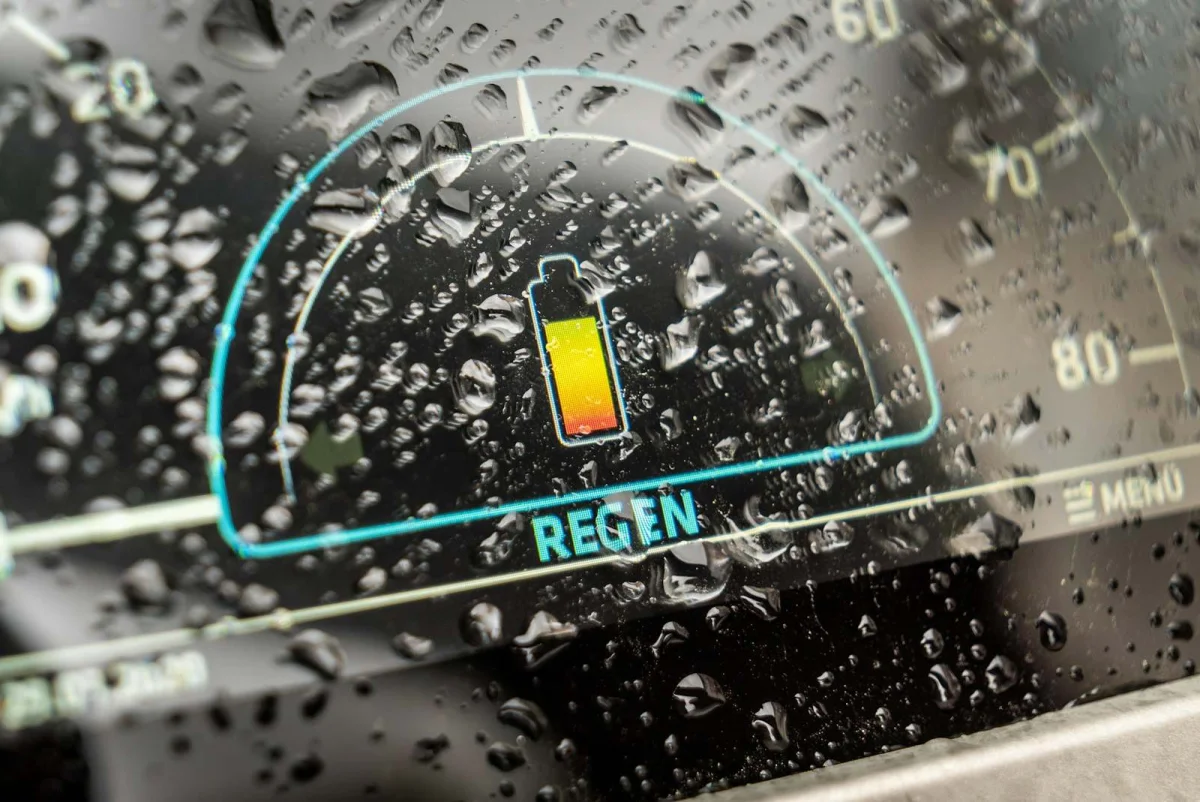
A hydrogen fuel cell vehicle and a battery electric vehicle contain the same amount of chemical energy measured in kilojoules — but the chain from fuel production to wheel motion has very different efficiency losses at each step, and those losses explain why battery electric vehicles use significantly less primary energy per kilometre despite hydrogen being energy-dense
The previous articles on this site covered energy unit basics, electricity bills and appliance costs, food calories and thermic effect, solar kW vs kWh, and why horsepower is a marketing unit. This article addresses energy in transportation — specifically the efficiency chain from primary energy source to vehicle motion, why energy density matters for range, and what the BTU-to-joule conversion reveals about US vs European energy reporting conventions.
The well-to-wheel efficiency chain
"Energy efficiency" in transportation is measured from primary energy source to wheel motion — the full chain, not just the motor efficiency:
Battery electric vehicle (BEV) chain:
- Electricity generation (grid mix): ~40-60% efficient if from natural gas generation, or effectively 100% if from renewables
- Grid transmission and distribution losses: ~7-8%
- Battery charging efficiency: ~90-95%
- Motor and drivetrain efficiency: ~85-90%
- Total BEV well-to-wheel: ~70-77% (from renewable electricity) or ~25-40% (from natural gas generation)
Hydrogen fuel cell vehicle (FCEV) chain:
- Hydrogen production (electrolysis): ~60-75% efficient
- Compression and transport: ~85-90%
- Fuel cell conversion: ~55-65%
- Motor and drivetrain: ~85-90%
- Total FCEV well-to-wheel from renewable electricity: ~25-30%
The "green hydrogen" paradox: even when hydrogen is made from 100% renewable electricity via electrolysis, the efficiency losses mean a fuel cell vehicle uses approximately 3× more renewable electricity per kilometre than a BEV. Both have zero tailpipe emissions, but hydrogen requires dramatically more renewable generation capacity for the same kilometres travelled.
Energy density: why hydrogen range is potentially large but storage is the problem
Gravimetric energy density (energy per unit mass) is why hydrogen is attractive as a fuel:
| Fuel | Energy density (MJ/kg) |
|---|---|
| Hydrogen (LHV) | 120 MJ/kg |
| Gasoline | 46 MJ/kg |
| Diesel | 45 MJ/kg |
| Lithium battery (current) | 0.72-0.90 MJ/kg |
| Lithium battery (theoretical) | ~2.5 MJ/kg |
Hydrogen has 2.6× the energy density of gasoline by mass — but hydrogen is a gas at room temperature and atmospheric pressure, with very low volumetric density. Storing hydrogen requires either:
- Compression to 350-700 bar (requiring a heavy, thick tank)
- Liquefaction to -253°C (just above absolute zero, requiring refrigeration and energy)
Volumetric energy density tells a different story:
| Fuel | Volumetric energy density (MJ/L) |
|---|---|
| Diesel | 35.8 MJ/L |
| Gasoline | 34.2 MJ/L |
| Compressed H₂ (700 bar) | 5.6 MJ/L |
| Lithium battery (current) | 0.9-2.6 MJ/L |
Compressed hydrogen at 700 bar has only 1/6 the volumetric energy density of diesel — requiring large tanks for the same range.
BTU, therm, and the US energy reporting system
US energy reporting uses different units from the international metric convention:
BTU (British Thermal Unit): the amount of energy needed to raise 1 pound of water by 1°F. Now defined as exactly 1,055.06 J. Used for: natural gas billing, heating system ratings, air conditioner capacity (BTU/hour of cooling).
Therm: 100,000 BTU = 105.5 MJ. A common unit for natural gas billing.
Quad: 10^15 BTU = approximately 1.055 × 10^18 J. Used for national energy statistics — "the US uses approximately 100 quads of energy per year."
The conversion confusion: a US gas boiler rated at "80,000 BTU/hour input" is 23.4 kW. A European boiler rated at "24 kW" is more directly interpretable without conversion. US energy efficiency ratings for appliances (EF — Energy Factor) use BTU; European ratings use kWh.
For electric vehicles: US EPA uses miles per gallon equivalent (MPGe) — converting the energy in one gallon of gasoline (33.7 kWh) and calculating how far the EV travels on that energy. European ratings use Wh/km or kWh/100km directly.
Calorific values and heating fuels
Natural gas energy content is described by its calorific value — the amount of energy released when the fuel is burned:
Gross calorific value (GCV, also "higher heating value" HHV): includes the energy released when water vapour in combustion products condenses. This is the theoretical maximum energy from the fuel.
Net calorific value (NCV, also "lower heating value" LHV): excludes condensation energy. Represents what's practically available from a conventional boiler.
Condensing boilers recover some of the condensation energy that conventional boilers lose — achieving efficiencies above 90% of GCV. This is why a condensing boiler rated at "92% efficient" sounds near-impossible: it's 92% of GCV, which is actually only ~105% of NCV (it recovers condensation energy that conventional boilers count as a loss).
How to use the Energy Converter on sadiqbd.com
- For appliance comparison: convert BTU/hour (US appliance ratings) to kW (European standard) — divide BTU/hour by 3,412 to get kW
- For electricity vs gas cost comparison: convert kWh (electricity) and therm (gas) to joules as a common base, then divide by respective unit prices to find cost per MJ of each fuel
- For solar sizing: convert your annual kWh consumption (from electricity bills) to understand daily kWh demand, then size the solar system based on local peak sun hours
Frequently Asked Questions
If I drive the same distance in a petrol car vs an EV, how much energy do I actually use? Approximately 3-5× more energy in the petrol car, when measured as primary energy (before the engine or motor). A typical petrol car uses approximately 5-8 kWh of fuel energy per kilometre (fuel energy, not just motion energy — petrol engines are ~25-35% efficient, so most energy is wasted as heat). A battery EV uses approximately 1.5-2.5 kWh per 10 km measured at the plug (charging 0.18-0.25 kWh/km including charging losses). The primary energy comparison depends on how the electricity was generated — from renewable sources, the EV uses far less primary energy; from coal-heavy grids, the advantage narrows but typically remains. Measuring "efficiency" at the fuel pump vs the plug creates an apples-to-oranges comparison that automotive and energy policy debates frequently exploit.
Is the Energy Converter free? Yes — completely free, no sign-up required.
Try the Energy Converter free at sadiqbd.com — convert between joules, kWh, BTU, calories, and more energy units instantly.