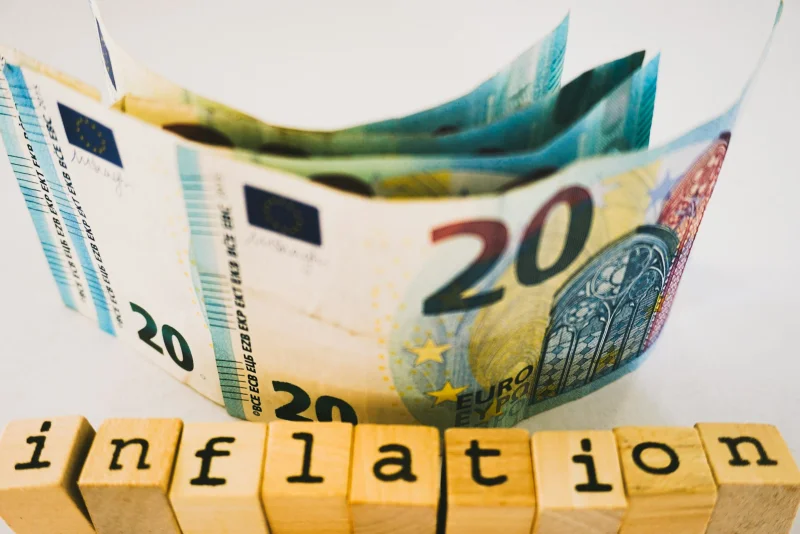
Inflation doesn't announce itself — it just quietly makes your plans obsolete
Most financial plans are built in today's taka. The salary you're targeting. The retirement corpus you've decided on. The amount you're saving for your child's education. All of these numbers feel real because they're anchored to today's prices, today's costs, today's lifestyle.
But if your plan takes 10, 20, or 30 years to execute, those numbers are almost certainly wrong. Not because your goals changed — because inflation compounds silently throughout that period, eroding the purchasing power of every taka you accumulate.
The Compounding Erosion of Purchasing Power
Inflation doesn't subtract linearly from your money's value. It compounds, just like interest — but working against you.
At 7% annual inflation, the purchasing power of ৳1,00,000 over time:
| Years | Purchasing power in today's taka |
|---|---|
| 5 | ৳71,299 |
| 10 | ৳50,835 |
| 15 | ৳36,245 |
| 20 | ৳25,842 |
| 30 | ৳13,137 |
After 30 years of 7% inflation, your ৳1,00,000 is worth only ৳13,137 in today's purchasing power. It still has the same number printed on it — but it buys what ৳13,137 buys today.
This means a retirement corpus of ৳1 crore, accumulated 30 years from now, is equivalent to roughly ৳13 lakh in today's purchasing power. If you need ৳1 crore in today's purchasing power, you actually need to accumulate approximately ৳7.6 crore in nominal terms.
How the Inflation Calculator Works
The calculator handles two related calculations:
Forward projection: What will today's amount be worth in N years at X% inflation?
Future value = Present value × (1 + inflation rate)^years
Backward projection: What was a past amount equivalent to in today's money?
Today's equivalent = Past amount × (1 + inflation rate)^years
How to Use the Inflation Calculator on sadiqbd.com
- Enter the current amount — the sum or cost you're evaluating
- Enter the annual inflation rate — 7% is a reasonable middle estimate for Bangladesh; use 8–9% for conservative planning
- Enter the number of years — how far forward (or backward) you're projecting
- Read the result — future value (what it'll cost then) or present equivalent (what it costs now in today's terms)
Practical Planning Scenarios
Retirement corpus in real terms
Farhan, 32, calculates he needs ৳80,000/month to retire comfortably. He plans to retire at 60 — 28 years from now. At 7% inflation:
Monthly expenses needed at retirement: 80,000 × (1.07)^28 ≈ ৳5,17,000/month
He's been planning for ৳80,000/month. He actually needs to plan for ৳5.17 lakh/month. His retirement corpus estimate needs to be built around this inflation-adjusted figure — not the figure that feels comfortable today.
Child's education in 15 years
A top private university today charges approximately ৳8,00,000 for a 4-year programme. At 10% education inflation (which tends to outpace general CPI):
Cost in 15 years: 8,00,000 × (1.10)^15 ≈ ৳33,36,000
More than 4× today's cost. A savings plan built around ৳8 lakh is dangerously underfunded.
Historical price reality check
A family paid ৳15,000/month rent in 2014. The same flat in 2024 rents for ৳32,000. Was that increase above or below inflation?
At 7% average inflation, ৳15,000 in 2014 is equivalent to: 15,000 × (1.07)^10 ≈ ৳29,506
The actual rent of ৳32,000 is ৳2,494 above what general inflation would suggest — rent increased slightly faster than the general price level in this case.
Salary adequacy check
You earned ৳50,000/month in 2019. You now earn ৳68,000/month (2024). At 6.5% average inflation during that period:
What ৳50,000 in 2019 is worth in 2024 terms: 50,000 × (1.065)^5 ≈ ৳68,567
Your raise has barely kept pace with inflation — you're essentially earning the same purchasing power, despite the nominal increase.
Sector-Specific Inflation Rates
General CPI inflation is a weighted average across many categories. Some sectors consistently inflate faster:
Education: Private school and university fees typically grow 8–12% annually — often double the general CPI rate.
Healthcare: Medical costs in South Asia have historically grown 10–15% annually. A ৳5,000 hospitalisation today might cost ৳13,000–20,000 in 10 years.
Urban property: In major Bangladeshi cities, property prices have appreciated 10–15% annually over the past decade — well above general inflation.
Food: Cyclical, with periodic spikes. Long-run food inflation has been 6–8% in Bangladesh.
Electronics and appliances: Often deflate in real terms — prices drop or quality improves at similar prices. Technology doesn't follow the inflation assumption.
Use sector-specific rates for specific financial goals. Planning for education or healthcare? Use 10–12%, not 7%.
Real Returns: The Number That Actually Matters
The real return is what's left after inflation:
Real return ≈ Nominal return − Inflation rate
More precisely (using the Fisher equation): Real return = [(1 + nominal) / (1 + inflation)] − 1
If your FD earns 8% and inflation is 7%: Real return = [(1.08) / (1.07)] − 1 ≈ 0.93%
You're growing in real terms, but barely. After tax (say 25% on the 8% return → 6% net), your real return is actually negative: [(1.06)/(1.07)] − 1 ≈ −0.93%
Your savings account is losing real value. This is why financial planners emphasise equity investments for long-term goals — not because equities are risk-free, but because their historical returns substantially outpace inflation over 10+ year periods.
Inflation and Fixed-Income Investments
This is the core tension in conservative investing:
- FDs and bonds feel safe because the nominal amount grows
- But if their return doesn't exceed inflation, you're losing purchasing power in real terms
- The "safe" choice isn't actually safe if it erodes the real value of your savings
A balanced approach: keep an emergency fund and short-term savings in FDs (stability, liquidity). For goals 5+ years away, allocate meaningfully to inflation-beating instruments.
Frequently Asked Questions
What inflation rate should I use for Bangladesh financial planning? Bangladesh's CPI has averaged 6–8% over the past decade, with recent years higher. For conservative long-term planning, 8% is a reasonable assumption. For very long horizons (20+ years), some planners use 9% to build in buffer.
How do I adjust a savings goal for inflation? Use the forward projection: enter your target amount in today's taka, the inflation rate, and the number of years. The result is the nominal amount you need to accumulate to have that purchasing power.
Is the "Rule of 70" useful for inflation? Yes — divide 70 by the inflation rate to get the approximate years for prices to double. At 7%: 70 ÷ 7 = 10 years for prices to double. At 9%: roughly 8 years.
Should I account for inflation in short-term financial plans (1–2 years)? For very short horizons, inflation adjustments are minor and often not worth the complexity. For anything 3+ years, inflation adjustment starts to matter materially.
Is the inflation calculator free? Yes — completely free, no sign-up required.
Inflation is the invisible tax on every financial goal. The inflation calculator makes it visible — converting vague concern into specific numbers that can be planned around.
Try the Inflation Calculator free at sadiqbd.com — see exactly what your money will be worth in the future, and what your plans actually need to account for.